The algorithm has a boss too
Week 1 · Trapped in the System
Photo: Javier Perez Montes, CC BY-SA 4.0, via Wikimedia CommonsAn order, from the outside
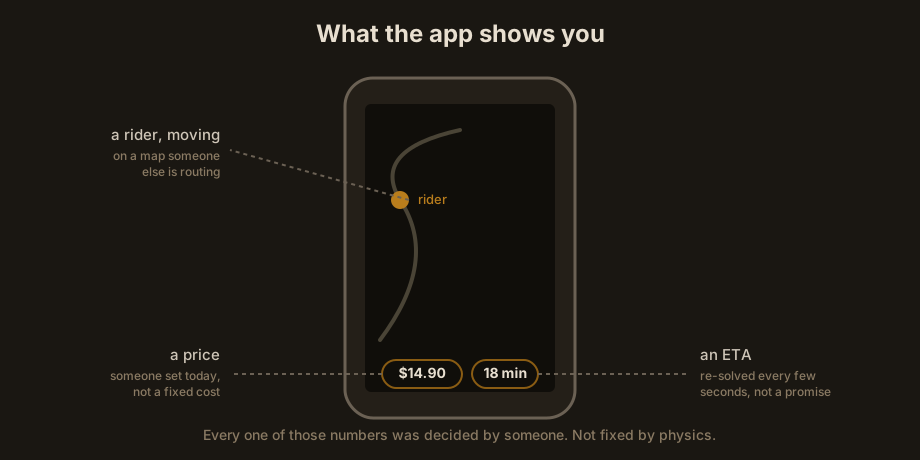
You order food. The app shows:
- a price
- an ETA
- a rider, moving on a map
Every one of those numbers was decided by someone. Not fixed by physics.
This course, in one line
This course is about who decided, and what it cost someone else.
What you’ll build toward
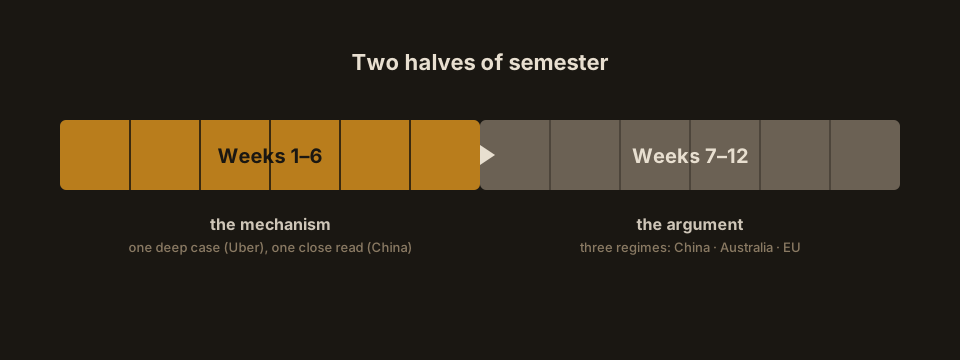
- Ten weekly checkpoints (wks 2–11) — small, specific, checked live
- System up close (wk 7) · Same algorithm, different country (wk 11)
- Redesign the dispatch (wk 12) — propose a mechanism, defend it
Now the actual topic: what “algorithmic management” means
Where the term comes from
Lee, Kusbit, Metsky & Dabbish (2015), Working with Machines: The Impact of Algorithmic and Data-Driven Management on Human Workers, CHI 2015
Software takes over decisions a human manager used to make: who does which job, how it’s rated, when someone is warned or let go. No robot boss required — just the deciding moving from a person into a rule nobody in the room can point to.
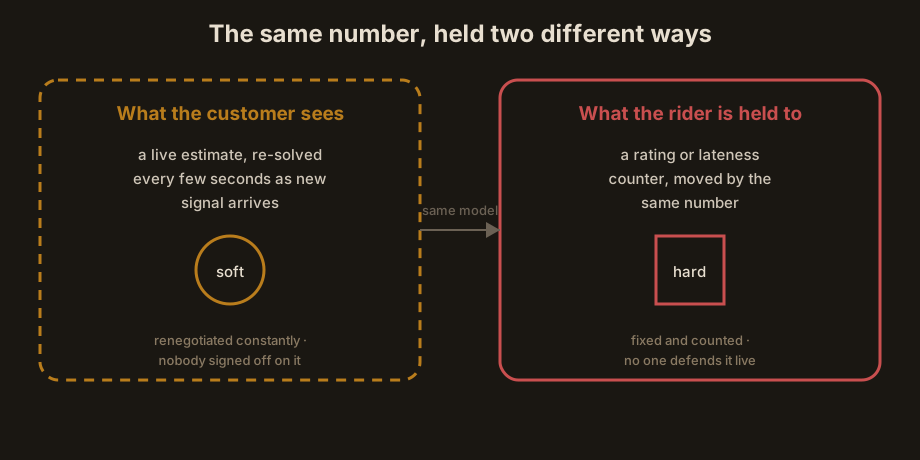
The same number, held two different ways
Why this course keeps returning to delivery
- almost the whole job — assignment, timing, rating — is decided by software before a human supervisor enters the picture
- a warehouse picker or call-centre agent usually still has a shift supervisor to appeal to; a bad call can be raised with a named person before it costs anything
- a delivery rider frequently does not: the app is the only interface, start to finish — the “appeal” is a support chatbot, or nothing
- that missing appeal step is not incidental to the case study — weeks 8–10 are largely about whether the law can manufacture one
The idea travelled
Kellogg, Valentine & Christin (2020), Algorithms at Work: The New Contested Terrain of Control, Academy of Management Annals
From a description of gig platforms to a general theory of workplace control — now cited in labour economics, organisational sociology, and the regulatory determinations weeks 7–10 read closely.
An algorithm is not a rule from nowhere. It is a decision, laundered through code, made by someone who will never meet the person it falls on.
Why “trapped in the system”
Renwu magazine, 2020, “Delivery Riders, Trapped in the System” — later covered in English by Sixth Tone
This is the piece that gave the problem its name in Chinese public discourse: “the rider, trapped in the system.” Week 3 reads it closely, alongside the coverage that carried it past a Chinese-language audience.
We will take that claim seriously enough to test it, not just repeat it.
The claim we’re testing
“The algorithm decided” can mean two very different things:
- an accurate description of a system too complex for anyone to have hand-specified the outcome
- a sentence that exists to make a paper trail stop at “the algorithm”
Telling the two apart is the actual skill — and the standard every essay this semester is held to.
Before week 2
Open a food-delivery app you don’t already use. Add items to a cart, step through checkout — no need to complete the order — and watch what the app tells you about time and price, and what it doesn’t.
That’s the raw material for the dispatch lab.