Provenance & Forensics
A folder of artefacts and no log.
The normal condition, not a special case.
Residue, not proof
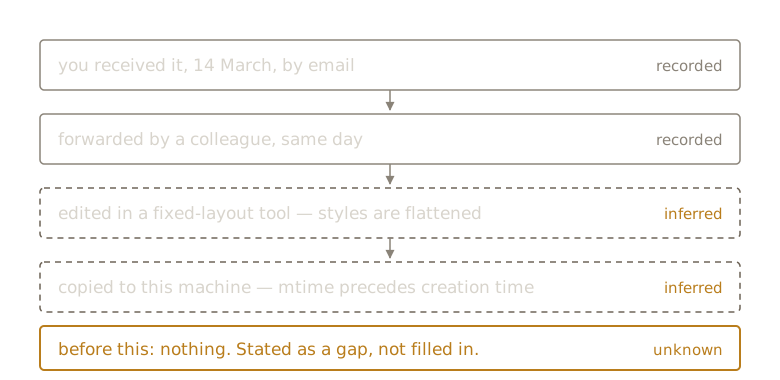
- mtime before creation time: copied here, not authored here
- an embedded application version: an edit placed within a range of years, sometimes an organisation’s licence
- flattened styles: passed through a fixed-layout format, whatever the extension claims
- a departed colleague’s name in a filename: who held it, and roughly when
Nobody curated any of it
Which is exactly what makes it useful.
And all of it is defeasible
Timestamps can be set. Metadata can be stripped by a tool with no opinion about it.
A reconstruction that doesn’t say what it’s unsure of is a story.
Archivists got here first
Provenance: keep records grouped by who created them, not reorganised by subject.
Chain of custody: record every transfer, so a gap reads as a gap.
1898
Three Dutch archivists publish a hundred rules for arranging archives.
Rule one, in effect: an archive is a product of its creator, and regrouping it by subject destroys evidence you cannot rebuild.
Endorsed internationally in 1910. Still the working principle.
Both say one thing
The history of a thing is part of the thing.
It cannot be reconstructed reliably once discarded.
Git did not invent an approach to provenance. It mechanised one that had been written down for a century.
Next week
Provenance answers what happened.
It doesn’t answer what to keep.
Sources
- Handleiding voor het Ordenen en Beschrijven van Archieven
- Archival Theory and the Dutch Manual archivaria.ca
- Digital Forensics and Born-Digital Content in Cultural Heritage Collections clir.org