Conversion Damage
Last week: two files, one named as the loser.
This week: one file, correctly named, opening fine, missing things.
The chain
DOCX → PDF → OCR → TXTComments, then layout, then characters, then structure.
What each format can hold
              comments  revisions  styles  layout  characters
DOCX             yes       yes      yes     flow    authored
PDF               no        no    glyphs    fixed   authored
PDF + OCR         no        no       no      no     guessed
TXT               no        no       no      no     guessed
Read down any column. It only ever degrades.
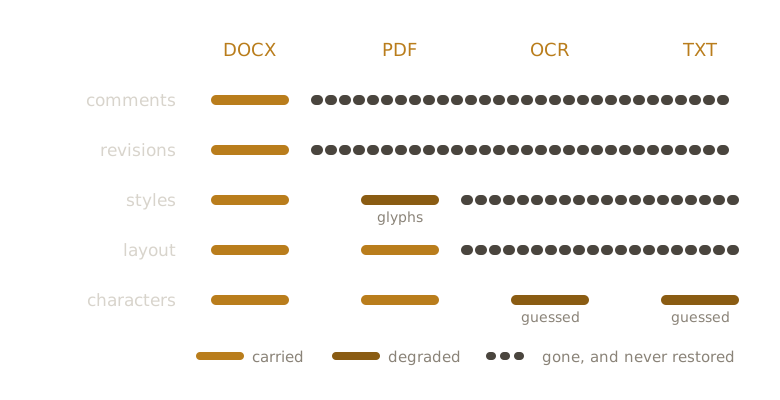
Nothing reports a failure
Every step produced a valid file in a valid format.
No step recorded what it dropped.
Losses don’t cancel
The second step can no longer tell an authored character from an artefact the first step introduced.
Round-tripping
DOCX → PDF → OCR → DOCX.
Original extension. Original application. Fails every week-2 identity test.
How wrong does OCR get?
In large newspaper digitisation programmes, practitioners treat above 98% character accuracy as good, 90–98% as average, below 90% as poor.
90% character accuracy is roughly one wrong character per ten. Nothing in the output marks which ten.
Next week
A history that is real but unrecorded.
Next: doing that work backwards.
Sources
- How Good Can It Get? Analysing and Improving OCR Accuracy in Large Scale Historic Newspaper Digitisation Programs dlib.org
- Ensuring the Longevity of Digital Documents scientificamerican.com