Sync Is a Lie
“In sync” is a status message, not a state.
What it actually means
As of the last successful exchange, no device reported anything the service couldn’t reconcile.
Not: the devices currently hold the same bytes.
The hard constraint
A sync service cannot ask you.
It decides immediately, using a timestamp, on clocks that don’t agree.
Last week’s four grounds
- Possession: meaningless, every device has a copy
- Position: unknowable, the service doesn’t know who your supervisor is
- Consensus: can’t be polled
- Recency: the only one left
So it uses recency
Which is why it is wrong on a predictable schedule.
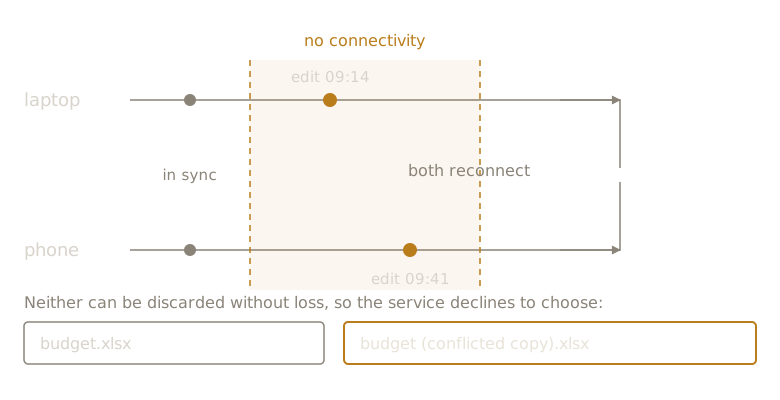
budget.xlsx
budget (Naledi's conflicted copy 2027-04-14).xlsx
Not a malfunction. The service declining a decision it has no authority to make.
The failure is downstream
Nobody reads the conflict copy.
It looks like litter rather than a finding.
It is not a bad service
Under a network partition, no system can be both fully consistent and fully available. That is a proved result, not a product decision.
The conflict copy is what choosing availability looks like from inside your folder.
Next week
A conflict copy preserves both versions intact.
Next: loss with nothing duplicated and nothing overwritten.
Sources
- Time, Clocks, and the Ordering of Events in a Distributed System dl.acm.org
- Brewer’s Conjecture and the Feasibility of Consistent, Available, Partition-Tolerant Web Services dl.acm.org