The Canonical Version
Who gets to say which copy is real?
Not a technical fact
A hash test can’t settle this. Neither can a timestamp.
Canonicity is a claim about authority.
Four grounds
- Possession: whoever holds the master copy
- Position: whoever’s role entitles them to decide
- Recency: whoever edited last
- Consensus: whoever most people currently defer to
The weak one
Recency is the most commonly used ground.
It is also the weakest. A timestamp is not a judgement.
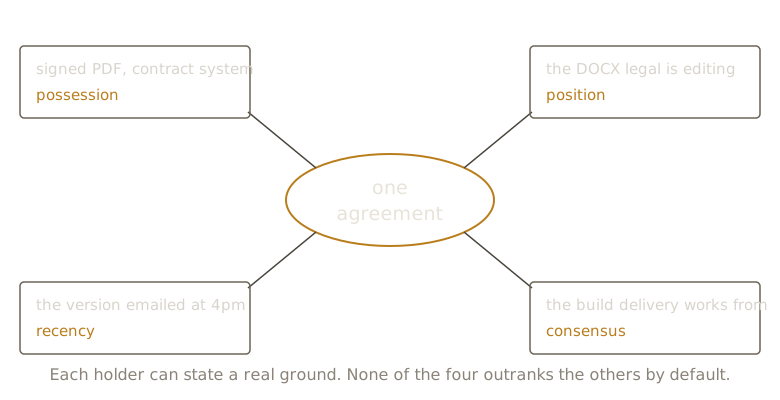
One agreement, four copies
signed PDF in contract system   possession
the DOCX legal is editing       position
the version emailed at 4pm      recency
the build delivery works from   consensus
Each holder can state a real ground.
They conflict
The most recent edit isn’t authoritative if the editor lacked standing.
Possession can lose to a court’s reading of a different copy.
Identity is a fact about files. Authority is a fact about people, and it has to be argued for.
Someone formalised this
Diplomatics: a seventeenth-century science, built to decide whether a charter was genuine.
Its modern descendants define an authentic record as one that is what it purports to be, and make that a presumption you argue for from evidence, not a property you read off the document.
Next week
A human applies these grounds with judgement, case by case.
What happens when a machine has to decide, automatically, with no human to ask?
Sources
- Diplomatics: New Uses for an Old Science, Part I archivaria.ca
- Requirements for Assessing and Maintaining the Authenticity of Electronic Records interpares.org