Merge Conflict
Not an error.
A system reporting that it has reached a decision it has no basis to make.
Most of a merge is arithmetic
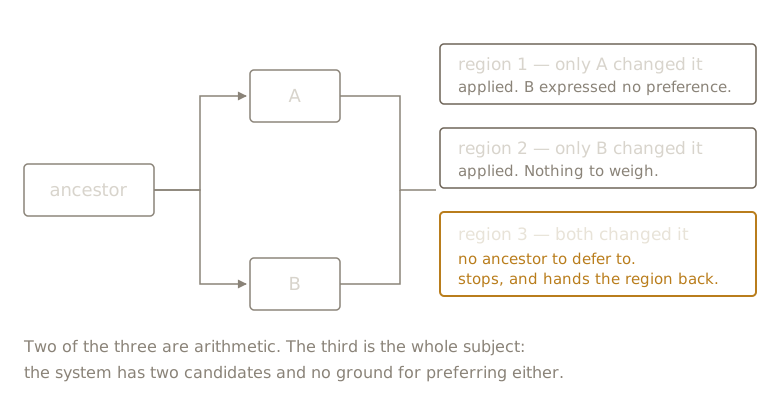
Common ancestor, two descendants. For each region: did one side change it, both, or neither?
One side changed it, the other didn’t: apply it. No preference expressed, nothing to weigh.
The one hard case
Both sides changed the same region, differently.
Two candidate texts. No ancestor to defer to. No ground to prefer either.
<<<<<<< HEAD
the committee reviewed the findings
=======
the committee noted the findings
>>>>>>> revision
Not stylistic variants
Reviewed and noted make different claims about what the committee did.
One of them becomes what the record says happened.
Three properties the tooling conceals
- Lossy: the discarded version goes nowhere a reader will find
- Unattributed: the file records who merged, not who was overruled
- Unexplained: no format has a field for why
A resolved merge looks exactly like text that was never contested.
Next week
Someone decided. The file reads as though there was never a question.
What entitled them?
Sources
- A State-of-the-Art Survey on Software Merging dl.acm.org
- A Formal Investigation of Diff3 cis.upenn.edu