The Diff
A machine cannot see that you rewrote a paragraph.
It sees lines present in one file and absent in the other.
What it computes
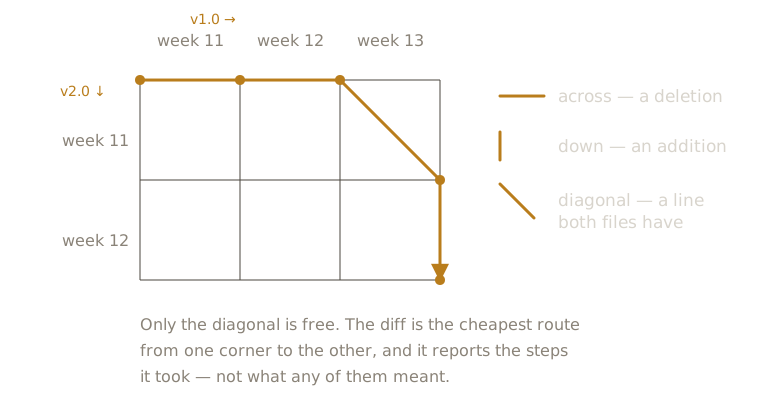
The longest sequence of lines the two versions share, in order.
Left over on the left: deletions. Left over on the right: additions.
There is no third category
A modified line is a deletion and an addition sitting next to each other.
The tool has no concept of modification.
Consequences
- Moved text reads as deleted and re-added
- Reflowing a paragraph changes every line in it
- A typo fix and a full rewrite look identical
- More than one diff of the same two files can be correct
Legible because mechanical
It reports what it observed, with no interpretation.
That is what makes it trustworthy.
And empty as a judgement
It can’t say which side is right: neither is wrong in any sense available to it.
It can’t say which change matters: significance isn’t a property of a line.
It can’t say why: intent was never in the file.
Complete as a report. Empty as a judgement.
Next week
The diff shows exactly what differs and nothing about what to keep.
Next: a system that tries to resolve it anyway, and has to stop.
Sources
- An Algorithm for Differential File Comparison cs.dartmouth.edu
- An O(ND) Difference Algorithm and Its Variations doi.org