Copies & Clones
Two files pass every identity test. Then someone edits one.
Duplication
Read the bytes. Write them somewhere else. Done.
A copy nobody touches is not a derivative of anything. It’s clutter.
Derivation
The claim that a copy now has its own purpose, its own audience, its own errors.
Nothing in the filesystem marks the transition.
Five people, five thresholds
- one edit
- a meaningful edit
- independent circulation
- a different audience
- enough divergence that reconciling would take real effort
None of these is a property of the file. Two can be satisfied while the bytes stay identical.
Why there’s no test for it
Derivation is a claim about how a file will be used from now on.
The bytes record what has happened. No property of what has happened can encode what is about to.
The judgement has consequences a hash can’t settle: who owns the result, which version a reader should trust.
Librarians split the difference
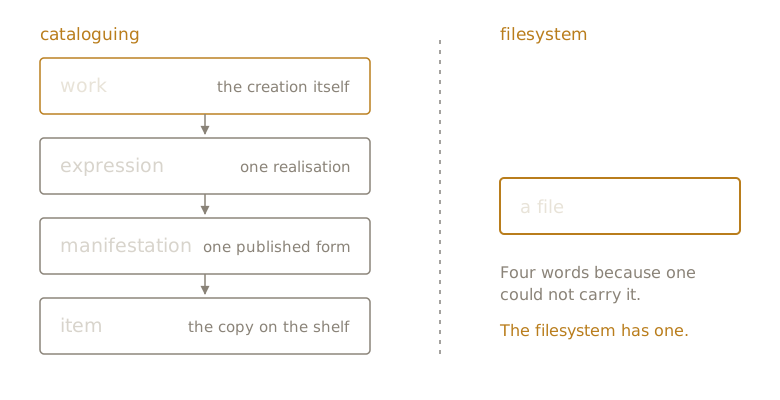
Cataloguing gives one creation four separate levels:
- work: the creation itself
- expression: one realisation of it
- manifestation: one published form of that
- item: the single copy on the shelf
Four words because one word could not carry it. The filesystem has one.
Next week
Two related, unreconciled versions. What people do about it.
Usually without ever using the word “branch.”
Sources
- Functional Requirements for Bibliographic Records: Final Report ifla.org