Your first data pipeline has a camera
Data Acquisition: Photography as a Quantitative Asset
SLOP1276 · Week 03 · Alex’s story
Fictional Alex opens three photo assets. A tidy crop hides context; a confidence score cannot identify the subject. The image needs a record.
Investigate: Which asset can the experiment reuse?
What you will be able to do
Record an image’s origin, permission and transformation.
Calculate a declared lighting ratio and an identification-failure rate.
Separate detection confidence from identity evidence.
Select and freeze a photo using inspectable information checks.
How this pack fits the week
60 minutes · Monday’s selected lecture slides.
90 minutes · Thursday’s four practical blocks.
About 210 minutes · independent preparation, remaining examples and consolidation.
The complete 180-minute route is a resource guide; its break is for a full sitting.
Alex’s facts stay fixed
Fictional adult CS student; board games and terrible puns.
Friday 5–7 pm · $20 total · bus travel.
Wants to meet someone, with the possibility of a relationship.
Our drawings represent the case. They do not add a real appearance or an invented hobby.
Bring the Week 2 boundary
Your platform audit separates inputs, observations and unknowns.
Apply it to images: where did the file come from, what changed, and what does it show?
A visible face is an observation. “This is Alex” requires supporting case information.
An image needs a history
Keep the original and the derivative. A crop is a new version, not an erased past.
Meet the three asset records
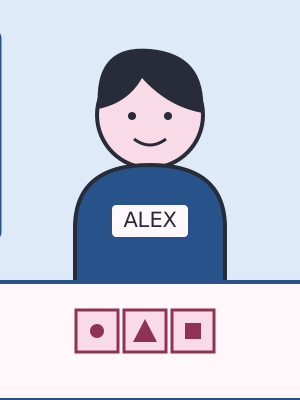 A · supplied identity
 B · partial second figure
 C · permission unknown
Which record would you inspect first before selecting an image for Alex?
Check provenance · 6 min
For A, B and C, record source, permission, intended subject and unknowns.
The kit deliberately leaves C’s exercise permission status unknown.
Does a sharp picture fill a missing permission field?
Use the supplied drawings and records; no camera or personal photograph is required.
Provenance debrief
All three files have a recorded course-drawing source.
A: supplied Alex label; exercise permission recorded.
B: permission recorded, but identity and crop context unresolved.
C: permission unknown in the exercise. Keep that gap visible; image quality cannot repair it.
Key and fill have different jobs
Nikon’s lighting introduction describes a main light and a fill that reduces shadows.
Declare what your ratio measures
For this exercise: key-to-fill = key reading / fill reading.
Use the same unit and measurement setup for both readings.
200 / 100 = 2:1.
This is our source-reading convention. It is not a measured bright-side/shadow-side ratio or a match predictor.
Four lighting records
L1 and L4 have the same ratio with different absolute readings.
Change the fill · 6 min
Keep the key reading at 200. Change fill from 100 to 50.
Calculate the new ratio. Then double both original readings.
What does each change preserve?
Finally, try fill = 0. Decide what the calculation should report.
Lighting answers
Halve fill: 200 / 50 = 4:1.
Double both: 400 / 200 = 2:1; the ratio is unchanged.
Fill = 0: the finite ratio is undefined. Flag it explicitly.
A ratio alone cannot reconstruct the image’s exposure, colour or background.
Background separation is another variable
Do not infer a light-meter reading from these colours. Record the background and lighting separately.
Design one controlled comparison · 5 min
Hypothesis: changing fill changes visible shadow detail in a chosen setup.
Specify what stays fixed: subject, pose, framing, background and camera settings.
Change one light input; define how shadow detail will be judged.
A proposed procedure using drawings is sufficient. This is not a dating experiment.
A useful capture record
Save the setup ID, source file, camera settings if applicable, key/fill readings and units.
Record the changed input and the annotation rule before comparison.
Our supplied readings support arithmetic only; they contain no measured shadow-detail outcomes.
Do not announce that the hypothesis passed without observations.
A crop is a transformation
Crop · 300 × 400Record x, y, width and height in the original coordinate system.
Count the retained area
A’s source is 600 × 400 coordinate units.
Its crop is 300 × 400, starting at (150, 0).
Retained fraction = 120,000 / 240,000 = 50%.
Half the area remains. That is not a 50% information score; inspect what the crop preserves.
Inspect the rectangle · 8 min
Use the A comparison: does the Alex label remain? Do the game tiles remain?
Check x + width ≤ source width and y + height ≤ source height.
Now try x = 450, width = 300 on the same source.
Decide whether this proposed crop is valid before discussing its style.
Crop debrief
Original crop: 150 + 300 = 450 ≤ 600; height ends at 400.
The supplied label and game tiles stay visible.
Changed crop: 450 + 300 = 750 > 600. Reject the rectangle.
Area arithmetic checks geometry. The image and annotation check meaning.
The partial-person problem
Crop · 330 × 360What can you say about the figure cut by the right edge?
Annotate without a biography · 6 min
A: “A second figure is partially visible at the edge.”
B: “That is Alex’s ex, cropped out.”
Which sentence describes visible evidence? What would justify the other?
Write an uncertainty note and a next action. Do not guess who either figure is.
Make the uncertainty inspectable
Accept A as a description. B invents identity and relationship history.
Record crop ambiguity = true and intended subject unresolved.
Keep the source and request a supported subject label or a different asset.
This is the “cropped-ex” variable: flag missing context, not somebody’s supposed relationship.
Detection answers a smaller question
Google’s ML Kit documentation explicitly separates face detection from recognising individuals.
Confidence cannot fill an identity field
In our mock record, B has confidence 0.98 but no supported intended-subject label.
Its score concerns the detector’s supposed task. It establishes no identity, compatibility or consent.
A has a lower mock score, 0.92, and stronger supplied identity evidence.
Choose the check that answers the actual question.
Pause for the full route · 10 minutes
For an uninterrupted full-pack session; skip this slide in Monday’s selection.
Leave one uncertain field in the manifest.
Next: turn “I cannot tell who this is” into an explicit annotation rule.
Then audit the denominator and the reviewers.
Define failure before counting
Rule: the supplied cues do not uniquely identify the intended subject.
These are neither match rates nor measurements of our three drawings.
Reproduce the rates · 6 min
Open identification-trials.csv in the photo kit.
For each category, count reviewer 1 failures and divide by that category’s trial count.
Check unique trial IDs and labels in 1.
State the event and denominator beside every percentage.
Two datasets, two denominators
Manifest: one ambiguous crop among three assets → 1/3.
Trial file: six identification failures among ten group trials → 6/10.
The assets and trials are separate fixtures. Do not join them as if they describe the same images.
Crop ambiguity and identification failure are different labels.
A pooled number needs a frame
Reviewer 1 marks 6 + 2 + 3 = 11 failures across 30 trials.
Pooled failure fraction = 11/30 ≈ 36.7%.
The three groups contribute equally here. With unequal trial counts, use total failures / total trials.
The result describes this constructed fixture, not photographs in general.
Same totals, different labels
Each reviewer reports six failures. Are their annotations identical?
Compare the reviewers · 4 min
Find every disagreement among G01–G10.
Compute agreements / trials.
Write one clarification that could help reviewers apply the subject-identification rule consistently.
If they agree, have they necessarily identified the subject correctly?
Agreement debrief
Disagreements: G06 and G07.
Agreement = 8 / 10 = 80%.
Both reviewers have six failures, but on different trials.
Agreement measures consistency between these labels, not correctness. A supported reference annotation is a separate requirement.
One label can move a small rate
In a separate sensitivity copy, change reviewer 1’s G06 from failure to pass.
Group failures fall from 6/10 to 5/10: 60% → 50%.
Keep the baseline and record the reason for the revision.
Invented trials cannot establish a universal ranking of photo categories.
Build a manifest, not a beauty score
Origin: asset ID, source and exercise permission status.
Transformation: original size, crop rectangle and revision.
Meaning: intended subject, supporting cue, ambiguity and alt text.
Review: decision, reasons and the exact file selected.
Alt text carries the relevant information
W3C’s informative-image guidance asks for a text alternative that conveys the image’s purpose and content.
Here, the subject label and visible crop matter to the exercise.
“Photo” loses that information. “Attractive and trustworthy” invents an assessment.
Describe what the reader needs for this task.
Write the alternative · 5 min
Write one sentence for A’s portrait crop.
Identify the fictional teaching image, its supplied Alex label and the relevant visible objects.
Then write B’s uncertainty note without inventing a relationship.
Compare your wording with the actual crop before opening the worked answer.
Alt-text worked answers
A: “Teaching illustration of fictional Alex, labelled on a blue top, behind a table with three game tiles.”
B: “Two unlabelled fictional adults; the rose figure is cut at the right edge. Their relationship is unknown.”
These descriptions use supplied or visible evidence. They add no personality, attraction or consent label.
Apply the acceptance checks
Require a recorded source, exercise permission, supported intended subject and valid crop.
Keep crop ambiguity explicit and supply relevant alt text.
Block missing required information before selecting an asset.
A high detector score cannot compensate for a failed permission or identity check.
Implement the audit · 8 min
Validate the three records, then return pass/block plus reasons for each.
Test a blank source and an out-of-bounds crop. Neither should pass.
Retain blocked records. Select from the eligible set, then freeze the file and metadata.
The downloadable workbook supplies assertions after your own attempt.
Selection: worked answer
A passes: supplied identity, permission record, valid crop and useful description.
B blocked: unresolved subject and ambiguous crop.
C blocked: unknown exercise permission and obscured subject.
One of three crops is ambiguous, yet only one of three assets passes. Those fractions answer different questions.
Freeze what Week 4 will compare
Bio A · same A-portrait-v1Bio B · same A-portrait-v1Record a file fingerprint with the revision. It detects changed bytes; it does not prove the image is truthful.
Repair the experiment · 4 min
Version A uses bio A and photo A. Version B uses bio B and photo B.
Suppose B receives more responses. Which change produced the difference?
Rewrite the comparison so that bio text is the planned difference.
Name the image fields that must remain fixed.
Handoff to the bio experiment
Use A-portrait-v1 for both bio variants: same bytes, crop, alt text and display treatment.
Keep the two rejected records and their reasons.
Changing both bio and photo cannot isolate a bio effect.
Week 4 adds the allocation and outcome rules. The photo manifest supplies its controlled image input.
Exit check · 3 min
1. Key 200, fill 50: what is our ratio?
2. Does the mock score 0.98 establish which figure is Alex?
3. Why keep the same crop when comparing two bios?
Answer using a formula, a boundary and an experimental control.
The image now has a record
Answers: 4:1; no; a changed crop introduces another changed input.
Alex freezes A-portrait-v1. The image is controlled; audience allocation is still a question. Week 4 investigates the bio dashboard.
Photo kit and calculations · Tutorial · Worked notes and sources