SLOP2462
Patterns of Change: Taiji, Bagua, and the Visual Logic of Transformation
Semester 1, 2027
How can a small set of visual symbols represent change and transformation?
What is SLOP2462?
A semiotics course on how a small set of visual signs can encode change itself, not just static categories.
- how a small visual vocabulary builds into a larger notation
how such a notation encodes transformation, not only static states
how interpretation of that notation accumulates and shifts across history
Teaching team
Marisol Quaye
Convenor
Designed the course’s twelve-week progression and its evidence-register discipline. Teaches most sessions and reads every submission at least once.
Idris Fenn
Tutor
Runs the small-group construction work in the first half of semester, and marks Assignment 1.
What you will learn
Construct
Line → bigram → trigram → hexagram
Transform
Explain how structural change is encoded, not just described
Compare & evaluate
Arrangements, historical claims, modern interpretations
Transfer
Apply the toolkit to a sign system this course never covered
How the 12 weeks fit together
- Framing — week 1
- Building the notation — weeks 2–8
- Historical reception — weeks 9–12
Today sits entirely inside the first band.
Assessment
| Category | Assignment 1 | Final project |
|---|---|---|
| Weight | 40% | 60% |
| Due | Week 8 · 12 April 2027 | Week 12 · 28 May 2027 |
| Demonstrates | Construction, the changing-line rule, arrangement comparison | Evaluating a modern claim; transferring the toolkit to a new sign system |
Exam & how the course works
No separate exam is listed. Assignment 1 and the Final project together make up 100% of the assessment.
- Lectures — concepts and examples
- Sessions — weekly guided, practical work
- Assessments — briefs and submission expectations
- People — teaching-team information
- Policies — course rules and expectations
Signs That Move
What does a sign system need, in order to represent change — not just a fixed state?
Naming a state vs. representing change
Most notations are good at naming something: a state, a pitch, a value.
Few are built, from the ground up, to represent a state becoming another state — inside the notation itself, not described around it.
State
A
versus
Change
A → B
Case 1 — a traffic light
Names three states — red, amber, green. The transition rule lives in the electronics behind the light, not in the sign itself.
Look only at the sign. You cannot tell what comes next.
Case 2 — musical notation
Names a pitch and a duration, read left to right as time. But a crescendo, a rubato, a held breath — most of what happens between marks is written beside the notation, not as a state the notation itself transforms through.
Case 3 — a state machine
Better again: the transitions are drawn explicitly, as arrows between states. But the rule for each transition still sits between the symbols — nothing inside “A” itself says it is about to become “B”.
Case 4 — binary code
Names a single two-valued unit. But nothing in “0” or in “1” tells you it is about to change, or into what — flipping happens to the bit, from outside it.
What these cases still lack
| System | What it names | Where the transition rule lives |
|---|---|---|
| Traffic light | three states | the electronics behind the light |
| Musical notation | a pitch and a duration | mostly an instruction to the performer |
| State machine | discrete states | the arrow between them, not the states |
| Binary code | a two-valued unit | outside the bit — flipping happens to it |
All four name a state clearly. None of them notate the transition itself.
This course studies another possibility
What if the notation itself could carry information about how it changes?
- A grid of 64 related figures, not one isolated sign
- Each figure built from six stacked solid and broken lines
- This course studies how that larger structure encodes change
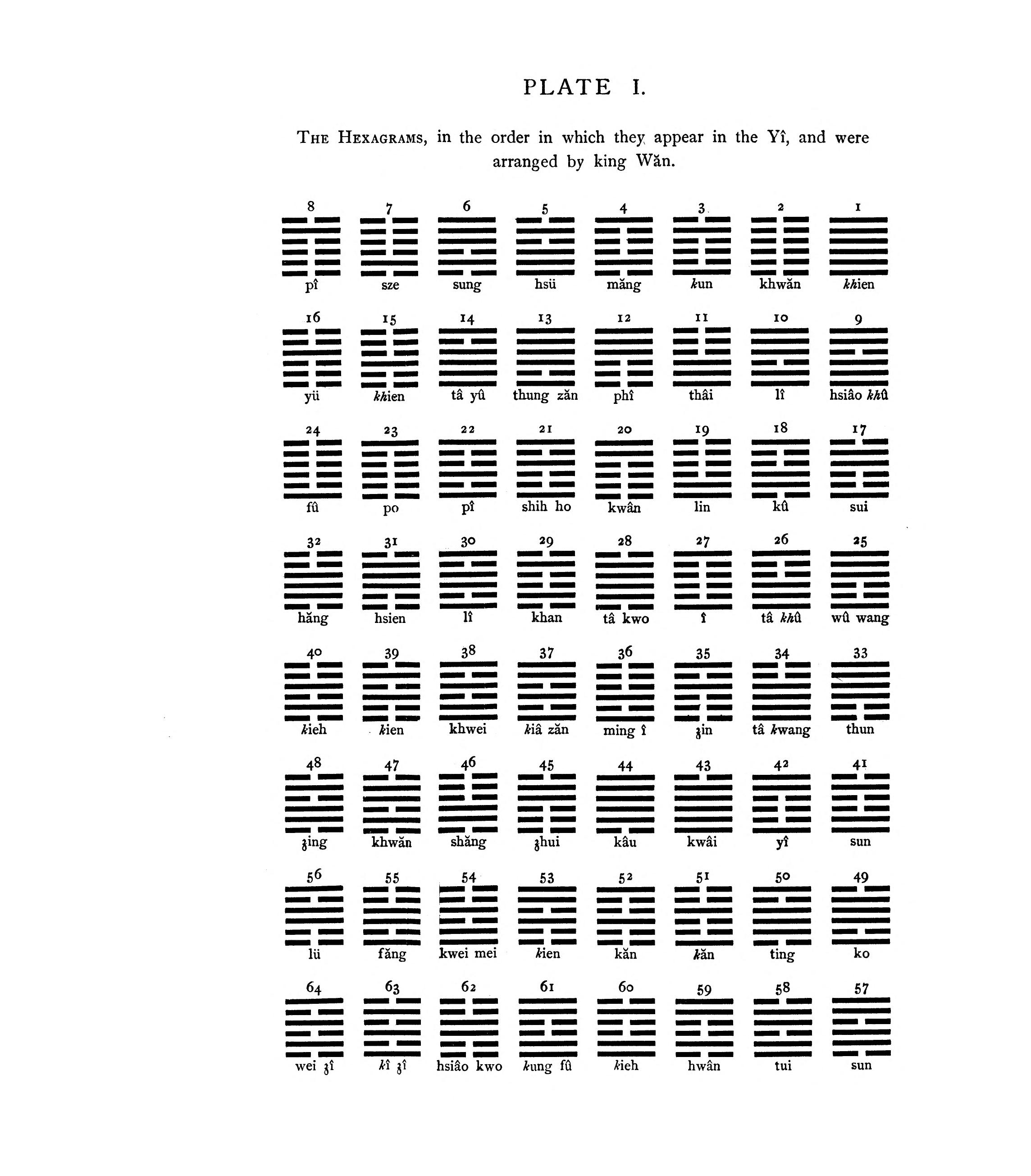
Source: James Legge (trans.), The Yî King, Plate I (1899).
Three questions for this course
- What are the basic marks?
- How can they be combined?
- How can the system encode transformation?
What comes next
- Week 2 — the smallest two-state distinction
- Weeks 3–4 — building combinations
- Weeks 5–7 — relationships and arrangements
- Week 8 — transformation
- Weeks 9–12 — history, interpretation, critical reading
Next week
One Splits into Two — the smallest visual distinction that can carry meaning.