Factorio: Engineering Addiction
Week 12 — The Factory Must Grow
UPS advanced
Week 11 established that UPS is a finite, shared budget. This week’s question is which entities spend that budget fastest — because count alone doesn’t answer it.
- for assembling-machine-type buildings, the number of machines is what costs UPS, not their speed — modules and beacons that let fewer, faster machines match the same output are a genuine UPS saving, not just a space saving
- inserters are a specific, callable-out cost of their own — cutting the number of inserters, or clocking them so they don’t check every tick, reduces this line directly
- biters and spitters sit in their own “Unit” entity class, separate from buildings — removing them removes that cost outright, which is why a base that’s cleared its perimeter runs measurably lighter than one still fighting off attacks
Pollution UPS
Pollution isn’t free to simulate either — it’s a cloud tracked per map chunk, updated on its own schedule, and it’s also what decides how often biters show up to cost UPS in the first place.
- each 32×32-tile chunk’s pollution updates every 64 ticks: once a chunk reaches 15.0 pollution it starts spreading outward in all four cardinal directions at 2% per 64 ticks, generating new chunks if it needs to spread into unexplored map
- a building’s actual output isn’t its listed base value — it’s
pollution multiplier × energy-usage multiplier × base pollution, so a heavily module-boosted machine can produce well above its own base figure, not just a flat bonus on top of it
Pollution UPS: the biter feedback loop
- pollution doesn’t just sit there — spawners absorb it to fuel attacks, so a heavier cloud means more frequent, bigger attacks: pollution converting straight into last slide’s biter-related UPS cost
- cutting pollution output (fewer, more efficient machines) is a UPS lever precisely because it starves what spawns the entities costing UPS elsewhere
Pollution by building
Count and type both mattered for machines two slides ago; pollution is the same story with different numbers, and one genuinely counter- intuitive result: a faster machine tier is not always the dirtier one.
| Building | Pollution/min |
|---|---|
| Boiler | 30 (highest in the base game) |
| Burner mining drill | 12 |
| Electric mining drill / pumpjack | 10 |
| Oil refinery | 6 |
| Chemical plant / centrifuge | 4 |
Pollution by building: assemblers and furnaces
| Building | Pollution/min |
|---|---|
| Assembling machine 1 | 4 |
| Assembling machine 2 | 3 |
| Assembling machine 3 | 2 |
| Steel furnace | 4 |
| Electric furnace | 1 |
Assembling machine 1 → 2 → 3 gets cleaner per machine as it gets faster — the same “fewer, faster machines” move that saves UPS on the entity-count side also cuts pollution on this side, for the same underlying reason: fewer machines running the multiplier formula above.
Pollution UPS, in practice
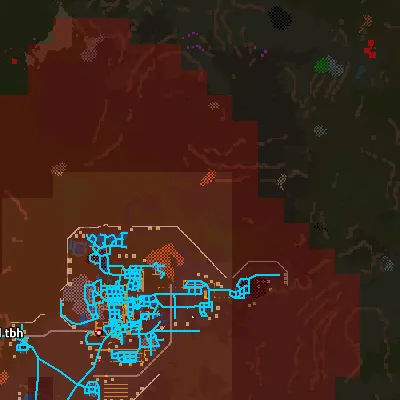
Source: Factorio Wiki, CC BY-NC-SA 3.0.
Those hard edges are the chunk boundaries the simulation actually updates along — the cloud isn’t smooth because the underlying calculation isn’t either.
Pollution, in practice
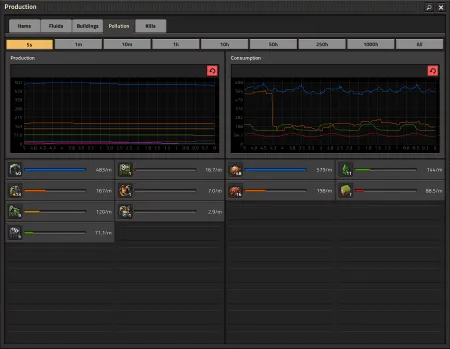
Source: Factorio Wiki, CC BY-NC-SA 3.0.
This is the per-building table two slides ago, live — the same breakdown, read off a running base instead of memorised.
What a cloud actually buys the biters
A spawner doesn’t launch an attack because pollution exists — it launches once it’s absorbed enough to afford one, on a schedule with real numbers behind it, not “eventually.”
- every 64 ticks, a spawner in a chunk above 20 pollution absorbs
20 + 0.01 × chunk pollution; below that threshold it absorbs three times the cost of the most expensive unit it could currently spawn instead — either way, it keeps absorbing until it’s banked enough to afford one - an attack wave costs pollution per unit added: 4/20/80/400 for small/ medium/big/behemoth biter, 4/12/30/200 for the spitter line — a heavier cloud doesn’t just trigger attacks sooner, it buys a bigger wave per trigger
From banked pollution to an attack
- once enough is banked, the spawner sends a unit to a rendezvous point; every 1-10 minutes (randomised) the mustered group launches, waiting up to 2 more minutes for stragglers still en route
- this is the mechanism behind “heavier cloud, bigger attacks” from the Pollution UPS slide earlier, not just a qualitative link — the same pollution that costs UPS to simulate is the exact currency spawners spend to cost more UPS later
Tile absorption
Chunks absorb pollution passively, at a rate set entirely by what’s covering the ground — not something a player action changes.
| Tile | Pollution/chunk/min |
|---|---|
| Water | -1.536 (fastest) |
| Grass, dirt | -1.106 |
| Red desert, sand | -0.922 |
| Paved tiles (concrete, stone brick), landfill | 0 |
Paving over ground for belts and floors is a UPS-neutral choice on its own, but it’s also a pollution-absorption choice — a base paved edge to edge is absorbing nothing at the perimeter where absorption would otherwise matter most.
Pollution sinks
Destroying a nest bumps evolution permanently (Week 5); leaving pollution alone lets it keep spreading. A pollution sink is a third option: wall off a cluster of nests, close enough that your own pollution keeps them docile without destroying them.
- this isn’t about pathfinding cost — the UPS bill for biters comes from the “Unit” class actually moving and fighting, not from sitting idle. A contained cluster that never joins an attack stays idle, so it never enters that cost line
- the trade-off is real estate and risk: the sink sits inside territory fenced off permanently, and a wall failure releases every contained nest at once
- a deliberate alternative to clearing everything (pays evolution) and ignoring everything (pays ever-growing attack size), at the cost of babysitting one more piece of infrastructure
Pollution sinks, in practice
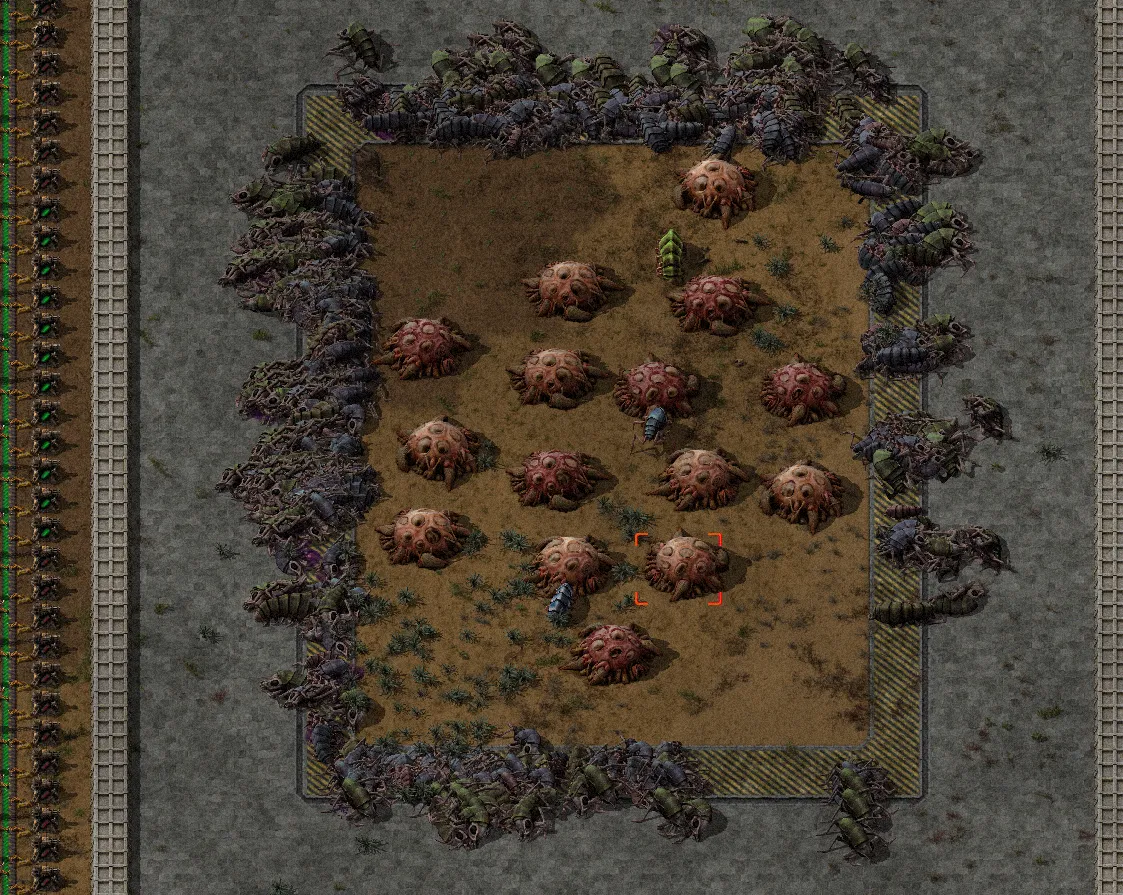
Source: Factorio Wiki, CC BY-NC-SA 3.0.
Every nest inside that wall is still there — it’s contained, not cleared, which is exactly the point: no evolution paid, no attacks launched.
Reducing base footprint
Week 2 framed footprint as a build-time and travel-time question. Run the same trade-off through a UPS lens and the answer doesn’t automatically match — a smaller footprint isn’t always a lighter one.
- footprint and entity count are related but not the same: a compact base of many small machines can hold more UPS-costing entities than a sprawling one built from fewer, larger ones
- beacons and modules that shrink a line’s footprint do so by cutting machine count for the same output — the same move that cuts UPS cost, so here both axes point the same way
- a smaller pollution footprint also means a smaller cloud, feeding back into fewer biter attacks — footprint, pollution and UPS are one concern viewed three ways
What causes lower UPS
Diagnosing a slow base means picking the right cause off this week’s checklist, not naming “too much stuff” — each candidate calls for a different fix.
- entity count: raw numbers — more machines, inserters and belts each add their own small cost; the fix is usually consolidation
- entity type: the same count of a cheaper entity type costs less than an expensive one — fewer, faster assemblers beat many slow ones
- pollution and biter activity: scales with output and spread, not base size — the fix is pollution reduction or a cleared perimeter
- clearing biters doesn’t help an entity-count problem, and consolidating machines doesn’t help a pollution problem
A slow base isn’t one problem wearing different masks. Entity count, entity type, and pollution are three different bills, and paying down the wrong one leaves the slowdown exactly where it was.
This week’s practical
Goal: audit a supplied base's UPS optimisation and remaining cost
Test: check it against this week's checklist — entity count, entity
      type, pollution and biter activity
Pass: optimisations correctly identified; remaining cost correctly
      attributed; a UPS problem is distinguished from a ratio problem
A production-ratio problem that looks like lag, and a UPS problem that looks like a bottleneck, are the two mistakes this course has spent twelve weeks teaching you to tell apart.