Factorio: Engineering Addiction
Week 10 — Advanced Optimisation
Logic gates
Decider and arithmetic combinators are the circuit network’s equivalent of an if-statement and a calculation — everything this week’s automation does is built from just these two.
- a decider combinator compares an input signal against a condition (greater than, equal to, and so on) and outputs a signal only while the condition holds — the network’s if-statement
- an arithmetic combinator takes one or two input signals and outputs the result of an operation on them (add, multiply, and so on) — the network’s calculation
- chaining a handful of these is enough to express “only run this while that other thing is true,” which is the pattern behind every example in this lecture
Wire colours are independent networks
Red and green wire aren’t a labelling convenience — they’re two entirely separate networks that happen to run down the same poles, and mixing that up is a common source of a circuit “not working” for no visible reason.
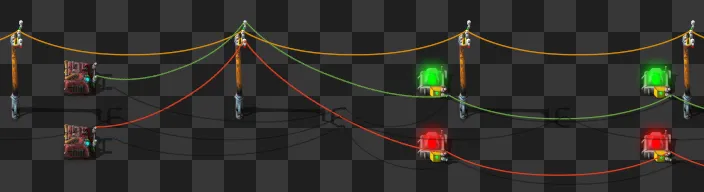
- wires of the same colour that touch anywhere — a shared pole, a shared device — merge into one network and sum their signals; a red wire and a green wire touching the same pole never merge, no matter how many devices sit on both
Reading combined signals across colours
- a device wired to both colours reads their sum: an inserter connected to a red wire carrying 20 copper plate and a green wire carrying 10 sees an input of 30, not two separate readings
- this is also how one pole can carry two logically unrelated networks at once — colour is the only thing keeping them apart, so a design that “shouldn’t” be seeing another circuit’s signal is almost always a same-colour wire touching somewhere it wasn’t meant to
Wire colours, in practice
Source: Factorio Wiki, CC BY-NC-SA 3.0.
One pole, two networks, zero interaction between them — the pole is just a waypoint for wire reach, not a point where colours combine.
Combinator timing
A combinator doesn’t react instantly — every update is split into a read-and-compute step and a broadcast step, one game tick apart, and that one-tick lag is what makes a combinator wired back to its own output dangerous.
- each of Factorio’s 60 ticks/second has two phases: first every combinator reads its input network and computes its output, then the network updates to the sum of everyone’s output — a decider’s output from this tick isn’t visible on the network until next tick
- that lag compounds through a chain: several combinators wired in series each add another tick of delay before a change at the start is visible at the end, which can desync signals that were meant to align
Feedback loops: runaway or clock
- an arithmetic combinator wired so its own output feeds back into its own input is a real hazard, not a hypothetical one — “add 1 to copper plate, output copper plate” wired back on itself climbs without bound, at a rate set by the tick rate, not a one-off increment
- the same feedback mechanism is also how deliberate clocks and counters are built — a runaway loop and a working clock are the identical circuit, the only difference is whether a reset condition is wired in to break the loop before it becomes a bug
Everything, anything and each
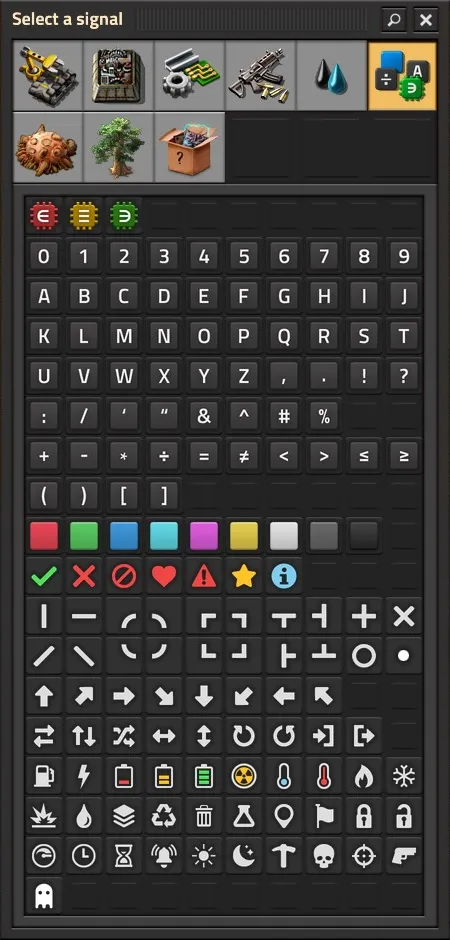
Three signals — Everything, Anything and Each — carry no value; they change what a combinator’s condition is evaluated against, letting one decider watch every signal on a wire instead of one named one.
- Everything on the input side is true only if the condition holds for every nonzero signal present (vacuously true if there are none) — universal quantification; a signal on the output side of the same comparison is excluded from the check, so “everything > iron plate” doesn’t trivially compare iron plate to itself
- Anything is true if the condition holds for at least one nonzero signal — existential quantification, false with no input at all; used as both input and output it returns the first matching signal (by Factoriopedia’s fixed ordering)
Each, and telling the wildcards apart
- Each runs the combinator’s operation once per nonzero input signal independently, then sums the outputs onto the wire — the wiki’s own description is a stack of identical combinators, one per signal, all wired in parallel; unlike Everything and Anything, a signal named on the output side is not excluded from the input set
- getting Everything and Each confused is an easy mistake with different results: Everything asks one yes/no question about the whole set, Each asks the same question once per signal and reports each answer separately
Wildcards, in practice
Source: Factorio Wiki, CC BY-NC-SA 3.0.
These three sit apart from every other signal in this dialog for a reason — they’re not values a wire carries, they’re instructions for how a combinator should read the values already on it.
Nuclear setups
A reactor’s output scales with how many other reactors touch it, which makes nuclear power a layout problem before it’s a fuel problem — and the same setup has one specific, well-known way to starve itself of fuel.
- every reactor gains +100% heat output for each orthogonally adjacent reactor — diagonals don’t count, and the bonus affects heat only, never fuel consumption
- a 2×2 block means each reactor touches two neighbours (+200% each), so four reactors produce far more than four times one — only in a tight, fully-aligned grid
Nuclear fuel and heat sizing
- fuel cells need 1 uranium-235 and 19 uranium-238 — raw processing yields U-235 only 0.7% of the time, so an uncontrolled line can drain a U-235 stockpile faster than processing replaces it
- heat exchangers, not reactors, are what the rest of the plant sizes against: one reactor with no neighbour bonus needs 4 heat exchangers to consume all its heat, plus 4 more per +100% of neighbour bonus stacked onto it — a large installation’s ideal ratio comes out to 2 pumps : 233 heat exchangers : 400 turbines, roughly 1:116:200
Uranium refining
Raw uranium processing alone can’t sustain a reactor — it only yields U-235 0.7% of the time, so a real setup needs a second step that turns U-238 into more U-235 instead of waiting on luck.
- the Kovarex enrichment process, run in a centrifuge, takes 40 U-235 and 5 U-238 and produces 41 U-235 and 2 U-238 per cycle — a net gain of 1 U-235 paid for with 3 U-238, not a one-for-one conversion
- it needs a 40 U-235 stockpile just to start a cycle, and won’t run below that floor — the process enriches an existing stockpile, it doesn’t bootstrap one from nothing
- once Kovarex is running, raw processing’s job shifts from “the” U-235 source to just supplying U-238 and the occasional lucky U-235 top-up
Nuclear setups, in practice
Source: Factorio Wiki, CC BY-NC-SA 3.0.
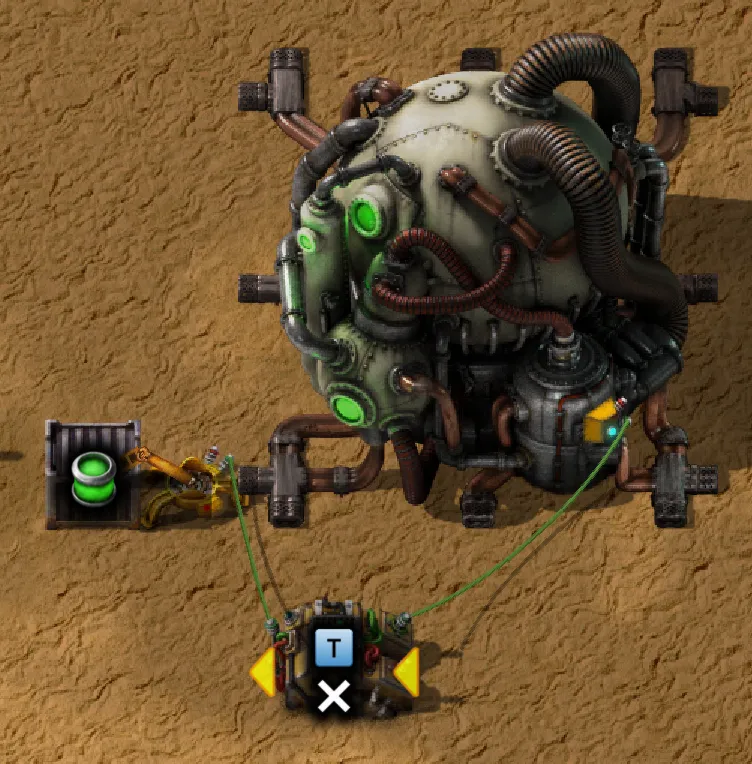
The decider combinator here is the gate: it’s what stops the inserter from loading another fuel cell before the reactor actually needs one.
Worked example: fuel timing
A fuel cell burns for exactly 200 seconds regardless of how much power is actually being drawn — nuclear doesn’t throttle fuel use to demand the way a steam engine does, so an ungated reactor burns cells on a fixed clock even while mostly idle.
- read one shared steam storage tank as the “steam is running low” signal — every reactor in a multi-reactor group listens to the same tank, not its own, so they can be kept in sync
- the output inserter (empty-cell removal) is enabled only when steam is low and a fresh cell is available in the input chest; removing the spent cell is itself the signal the input inserter waits for
Fuel timing, continued
- the input inserter has its stack size overridden to 1, so exactly one fresh cell goes in per empty-cell signal — never a stack at once
- for a multi-reactor block, only one output inserter should be wired to the shared steam signal; every other reactor’s output inserter runs “dumb” (removes empty cells immediately) and follows the first reactor’s insertion via the empty-cell signal — this is what keeps refuelling synchronised enough to hold the neighbour bonus
Worked example: uranium prioritisation
Nuclear fuel production competes with every other use of uranium for the same two isotopes — this circuit keeps a reserve for fuel production before anything else gets a share.
- split incoming uranium onto two parallel belts (U-235, U-238), each read by an inserter gathering into its own container
- gate each gathering inserter on “belt ≥ X” and each belt itself on “container ≤ X,” with X set to the fuel-cell recipe’s own requirement — 1 U-235, 19 U-238 — so gathering only pulls uranium below that reserve floor, and the belt only keeps supplying downstream users once the reserve is topped back up
Uranium prioritisation, continued
- gate the inserters feeding the fuel-cell assembler on “nuclear fuel stockpile = 0” (or below a chosen threshold), so uranium only leaves the reserve to make more fuel once the existing stockpile is actually low
- net effect: uranium flows to other uses by default, gets held back the moment the fuel reserve dips, and only feeds fuel production once there’s a genuine shortfall — the reserve is protected without ever stopping the belts outright
Logic-based rails
A train stop isn’t limited to a fixed schedule — its dispatch behaviour can be driven directly by circuit signals, so a train only comes when the network’s actual state calls for it.
- enable/disable: a circuit condition can switch a stop on or off; a disabled stop is skipped in favour of another stop sharing its name, or the train waits if none are available
- train limit: a circuit signal can set how many trains may currently be heading to a stop — a limit of 0 behaves identically to disabling the stop outright
- priority: when several stops share a name, a circuit signal can also set which one trains prefer, on top of enabling or limiting them
On-demand trains
Combining a stock-level signal with a train stop’s circuit conditions turns “run a train every N minutes” into “run a train when the station actually needs one” — the difference between guessing and reacting.
- reading a chest or tank’s contents as a signal, then wiring that signal into the pickup station’s enable condition, means a train is only dispatched once there’s enough to justify the trip
- the same pattern at the delivery end — disabling the destination once its buffer is full — prevents a train arriving somewhere that has nowhere to put the cargo
- this is the same if-statement pattern from the start of this lecture, applied to a schedule instead of a single machine
Hysteresis and the SR latch
A condition that switches on and off right at its own threshold doesn’t stay off — it chatters, flipping every tick the reading crosses back and forth across the line. A latch fixes this by giving “on” and “off” different thresholds instead of one shared one.
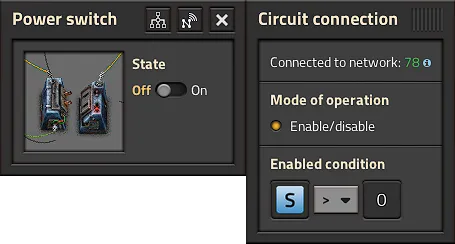
- an SR latch remembers a state instead of just reporting a condition: it sets (“remembers on”) when a set condition is met, and only resets when a separate reset condition is met — as of Factorio 2.0 a single decider combinator, correctly configured, is enough to do this
Hysteresis, continued
- the canonical example: turn a backup steam generator on when accumulator charge drops to 20%, but don’t turn it back off until charge recovers to 90% — a single shared threshold (say, 50%) would cycle the generator on and off repeatedly as charge hovers near it
- this gap between the set and reset thresholds is hysteresis on purpose — it’s not slop in the design, it’s what stops a power switch (or any other latched output) from rapidly cycling near a boundary value
Hysteresis, in practice
Source: Factorio Wiki, CC BY-NC-SA 3.0.
The power switch only cares about one signal being 0 or 1 — all the hysteresis logic lives upstream, in the single decider combinator deciding when that signal flips.
A fixed timer runs whether or not the network needs it. A circuit condition runs because the network needs it — that difference is the entire point of this week.
Every example tonight — reactor fuelling, train dispatch — is the same gate, wired to a different question.
This week’s practical
Goal: a circuit-controlled uranium processing setup that runs
      continuously without jamming or starving
Test: vary the ore supply rate and confirm the setup holds unattended
Pass: no jamming across a supply-rate change; at least one circuit
      condition (not a fixed timer) governs part of the process; the
      failure mode it guards against is stated
State the failure mode before you wire the fix — a circuit condition that’s just there because it seemed like a good idea isn’t the same as one guarding against a stated way the setup jams.