Factorio: Engineering Addiction
Week 7 — Coordinating at Scale
One shared factory
Cooperative multiplayer puts every player on the same force by default: one shared technology tree, one shared logistics and construction-robot network, no walls between what any one player built. Everything from here is a consequence of that.
- research points contributed by any player advance the same tech tree — there’s no such thing as “your” research finishing before “mine”
- construction and logistic robots serve the whole force’s network, not whoever placed the roboport — a bot will happily carry your teammate’s request
- there is no built-in ownership of a build — anything one player places, another can walk up to and rebuild, wire into, or tear out
Multiplayer and the inefficiency of differing solutions
Because the factory is genuinely shared, two players solving the same subsystem independently doesn’t produce two solutions to compare — it produces one broken subsystem, built twice, in the same space.
- a second red-science line built next to an existing one without coordination usually means both compete for the same ore patch or belt lane, not that the base now makes twice as much
- rework compounds: fixing a collision after the fact costs more than agreeing on one design before either player starts
- this is a coordination problem, not a skill problem — two competent players with no shared plan produce worse results than two players with a plan and less individual skill
Role allocation
Splitting the base into owned zones or subsystems gives every decision exactly one owner, which is what actually prevents the collision above — not skill, not communication volume, just a clear boundary.
- a zone can be spatial (the north ore patch), or functional (whoever owns “science” owns every lab and every belt feeding one, wherever it physically sits)
- an owner doesn’t mean nobody else touches it — it means disputes about that zone resolve to one person, instead of staying unresolved until something breaks
- role allocation has to happen before building starts, not after — retrofitting ownership onto a base that’s already half-built by two people with different plans is the expensive version of this problem
Management: conventions that scale
Beyond who owns what, a small set of conventions agreed once removes the need to ask before every decision — the team scales past “constantly checking with each other” to “trusting the convention holds.”
- a shared belt-colour or item convention means a player extending someone else’s line doesn’t have to ask what’s on it
- consistent train stop naming lets every player read a schedule and know what a stop is for, without asking whoever built it
- agreeing on bus contents (what’s on it, in what order, at what width) before either player starts building against it avoids the single most common cross-player collision in a shared base
Management, in practice
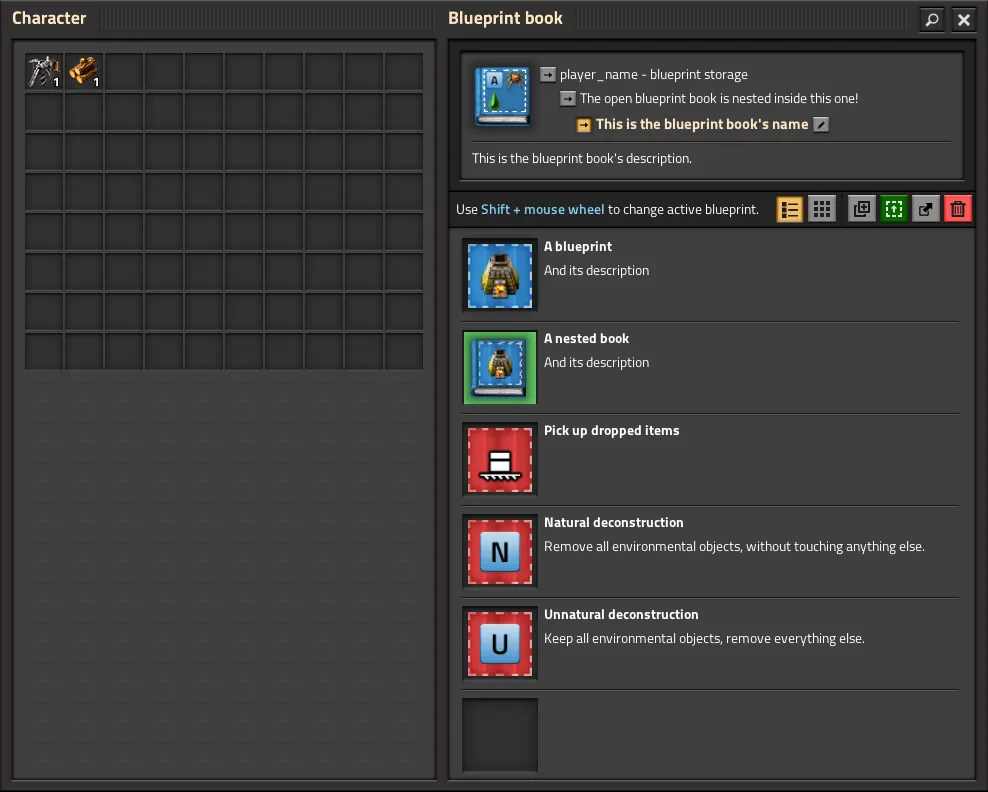
Source: Factorio Wiki, CC BY-NC-SA 3.0.
A blueprint book with named, described entries is a convention made durable — the agreement doesn’t live only in a chat log, it’s sitting in the game, ready for anyone on the team to place.
Two competent players with no shared plan will out-build each other before they out-build the factory.
Role allocation and shared conventions aren’t overhead on top of the building — they’re what makes the building add up instead of cancel out.
This week’s practical
Goal: form the Group Project team and agree on how it will work, before
      anyone touches the shared save
Test: the group is recorded, roles are assigned, a convention is written
      down
Pass: a group is formed and recorded before the tutorial ends; each member
      has an assigned zone or subsystem, agreed by the group; a shared
      convention (belt colour, stop naming, or bus contents) is written
      down, not left implicit
The save this produces is the one Assignment 2 marks at the end of Week 12 — the conventions agreed today are the ones the whole project has to live with.