Factorio: Engineering Addiction
Week 4 — Ratios and Bottlenecks
Input/output ratios
Every recipe is a rate problem in disguise: a crafting time plus an ingredient list is enough to work out exactly how many machines of each kind a line needs, with no trial and error involved.
- a machine’s output rate is
1 / crafting timeitems per second, scaled by its crafting speed — a stone furnace smelting iron plate (3.2s at speed- makes 0.3125 plates/second, an electric furnace (speed 2) makes 0.625
- to match a downstream consumer’s demand, divide its consumption rate by the upstream machine’s output rate — the result is how many machines to build, not a number to round down casually
- getting this from the recipe, not “add furnaces until it looks enough,” is what makes a ratio something you can state and defend
Fluid systems
Fluids are not items on a belt. A pipe (or a connected run of pipes and tanks) holds fluid as one continuous, shared quantity — not discrete units occupying slots.
- a connected run of pipes not broken by a pump is a single “segment”: the fluid level equalises across the whole segment as pressure, not as individual units queuing
- each connection point (a machine or pump) is capped at a theoretical maximum of 6000 fluid/second (100/tick); in practice this settles around 4200 fluid/second per connection — a machine with two output sockets for the same fluid effectively doubles that, to ~8400/second
Fluid pressure and distance limits
- flow speed depends on how full the segment already is — nearly empty fills fast but drains slowly, nearly full is the reverse; 12,550 units into a 25,000-unit tank via one 100-unit pipe settles at 12,500 in the tank and 50 in the pipe, both at the same 50% of capacity, not the same absolute amount
- pumps aren’t just for speed — they split one long segment into several; an unpumped run stops equalising past 320×320 tiles (10×10 chunks), a hard distance limit regardless of pipe count
- a machine with both an input and output socket for the same fluid (e.g. an electric mining drill over uranium ore, drawing sulfuric acid) drains fluid for its own recipe first — once its input is full, the extra sockets behave like an ordinary pipe equalising with its neighbours
Fluid systems, in practice
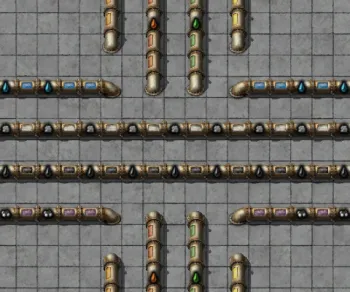
Source: Factorio Wiki, CC BY-NC-SA 3.0.
Each pipe here is one fluid at one shared level — there’s no belt-style gap between one unit and the next.
Pipe distance limits, in practice
Source: Factorio Wiki, CC BY-NC-SA 3.0.
Past 320 tiles unpumped, the far end of this run simply stops participating in the shared level — a pump doesn’t just speed the run up, it’s what makes the far end part of the same segment at all.
Crude oil to petroleum gas
Basic oil processing turns crude oil into petroleum gas, light oil and heavy oil in fixed proportions — useful early, but it leaves you with heavy and light oil you may not need yet.
- advanced oil processing (adds water) shifts the mix and adds cracking: a chemical plant cracks heavy oil into light, and light into petroleum gas, on a surplus of the heavier fluid
- the oft-quoted ratio for pure petroleum gas is 20 refineries : 5 heavy-cracking : 17 light-cracking (8:2:7 close enough) — assuming none of the heavy or light oil is wanted elsewhere
- once lubricant or rocket/solid fuel matter, a fixed ratio over-cracks — most factories gate cracking on actual surplus instead
Modules
Modules are a ratio decision before they’re a power-cost one — each type trades a different set of stats, and the trade only pays off if the recipe and the machine’s role can absorb it.
- speed modules: +20% / +30% / +50% crafting speed by tier, at a cost of +50% / +60% / +70% energy consumption — pure throughput, no output bonus
- productivity modules: +4% / +6% / +10% extra output for free by tier, at a cost of +40–80% energy and −5% to −15% crafting speed — only legal on recipes that produce intermediate products, not on every recipe
- efficiency modules: −30% / −40% / −50% energy consumption, tier for tier, with no speed or output change at all
Module stacking limits
Stacking modules of the same type doesn’t scale forever — both speed’s energy cost and efficiency’s savings hit a hard floor before the slots run out.
- energy consumption from module stacking can’t be pushed below 20% of a machine’s unmodified base value, no matter how many speed or efficiency modules are involved
- efficiency modules cap total consumption reduction at −80% — three already gets close: an electric mining drill’s normal 10 pollution/min drops to 2 (an 80% cut) with three basic efficiency modules
- an electric furnace draws 180 kW unmodified; one basic efficiency module alone cuts that by 54 kW (−30%) — close to a solar panel’s worth of demand, from one module slot
Productivity module exceptions
Productivity’s free-output bonus is powerful enough that the game explicitly excludes it from a short list of recipes, and reserves it for where the payoff compounds.
- productivity modules can’t go in every recipe — barrel filling, barrel emptying, producing barrels from steel, and steam condensation are all named exclusions, mostly recipes the wiki notes could otherwise loop resources for free
- productivity modules pay off at scale: three productivity module 3s in a rocket silo cut total resource cost per launch by almost 30%, saving roughly 26,000 copper ore per rocket
Beacons
Module effects from multiple modules in the same machine add up linearly. A beacon extends a module’s effect to nearby machines without taking up their module slots.
- a beacon covers a 9×9 tile area, holds 2 module slots, and transmits each module’s effect at 150% distribution efficiency per beacon — before the diminishing-returns rule below, one beacon alone already transmits more than a straight 1:1 copy of what’s in its slots
- transmitted effect scales with the square root of beacon count, not linearly: 1 beacon reaching a machine gives 150% total effect, 2 beacons give 212%, and by 20 beacons reaching one machine the total is 671% — but the marginal gain from that 20th beacon is only 17%, against 62% from the second
Beacon coverage strategy
That square-root falloff is what turns beacon placement into a coverage problem rather than a “more is better” one.
- a beacon’s transmitted strength drops as more beacons reach the same machine — coverage shared between machines beats stacking beacons onto one, precisely because of that square-root falloff
- productivity modules can’t be placed in beacons at all — only speed and efficiency modules transmit
Modules and beacons, in practice
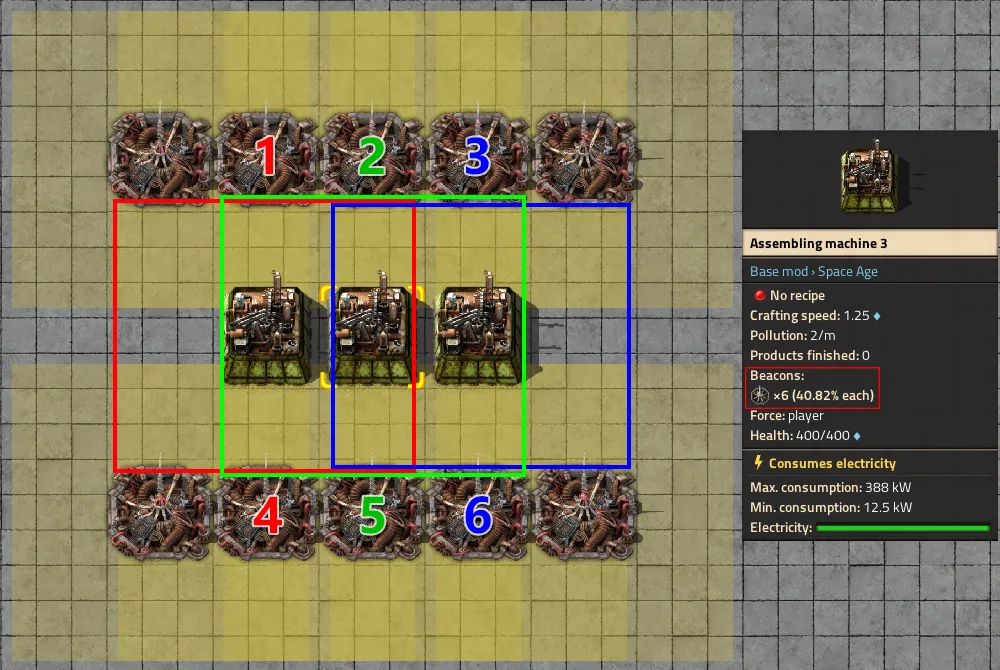
Source: Factorio Wiki, CC BY-NC-SA 3.0.
Read the tooltip, not just the picture — six beacons reaching one machine transmit at a fraction of what one beacon alone would, which is why beacon layouts are designed around sharing coverage between machines, not stacking it onto one.
On-site versus belted-in intermediates
An intermediate product — a gear, a circuit, a cable — can be made right next to where it’s consumed, or carried in on a belt from a central production line. Neither is free.
- making it on-site avoids competing for space on a shared bus belt, but duplicates that production step everywhere it’s needed, and duplicates the mistake if the local ratio is ever wrong
- belting it in from one central line means the ratio only has to be worked out once, but adds that intermediate to the bus’s belt-count budget, and a bus has a limited number of belt lanes to spend
- this is the same trade-off Week 2 raised between spaghetti and the bus, now applied at the scale of a single intermediate rather than a whole base
Chaining assembling machines
A ratio that balances two machines doesn’t automatically balance a longer chain — each extra step multiplies in its own crafting time and ingredient count, and small roundings compound.
- electronic circuits need copper cable, itself a crafted intermediate (1 copper plate → 2 copper cable, 0.5s) — under-provision the cable assemblers by even one machine and the circuit line never sees it
- work a chain from its last step backwards: fix the desired output rate, divide back through each step’s ratio, and round every machine count up, not down — rounding down reintroduces the shortfall the calculation was meant to prevent
- a rounding shortfall at step two of five doesn’t look like a step-two problem downstream — every later machine looks randomly starved, because in effect it is
A ratio you can state and defend beats a ratio that happens to work today.
The whole point of doing the arithmetic is that “it looked fine yesterday” isn’t a ratio.
This week’s practical
Goal: fully automate red or green science packs, raw ore to lab feed
Test: run the line unattended for a sustained period
Pass: no assembler sits starved or backed up, and the ratios used are
      stated, not arrived at by trial and error
State the ratio for every step before you build it — the build is there to confirm the arithmetic, not to substitute for it.