Week 10
Cry wolf: trust and alarm fatigue
What happens to a warning system’s credibility the tenth time it’s wrong?
Learning objectives
By the end of this week you should be able to:
- explain why a false-alarm rate is a chosen tuning parameter of an ADAS system, not a defect to be engineered away
- trace the alarm-fatigue research lineage from 1970s–80s aviation cockpit studies to present-day automotive ADAS research
- identify a documented, real example of drivers habituating to or disabling a specific driver-assistance feature, and state why
- compare a high-sensitivity and a high-specificity tuning of the same ADAS feature and state the trade-off each one implies for the driver
- describe the alarm-fatigue feedback loop as a cycle that repeats and degrades, not a single one-way failure
Opening example: the commute that cries wolf
A driver takes the same route to work every day. Halfway along it, a stretch of resurfaced road has lane markings that haven’t been repainted yet — thin, inconsistent, partly worn away by a winter of traffic. Every morning, in that same stretch, the lane-departure warning chimes and the wheel gives a small corrective tug, even though the driver hasn’t drifted anywhere.
By the second week of this commute, the driver reaches for the button that turns lane-keeping off before they even get to that stretch of road — not because the feature is worthless, but because in this one place, on this one drive, it has never once been right.
Opening example: what the car is trying to say, and why this matters
The car isn’t malfunctioning in the usual sense. Its sensor is reading the road exactly as instructed and concluding, reasonably from the pixels it has, that the car has crossed a line it hasn’t repainted. The alert is doing its job as specified; the specification is what’s failing in this one, entirely predictable, condition.
This matters because the same system, on the same drive, might one day detect a real departure — a moment of drowsiness, a genuine drift into the next lane. If the driver has already trained themselves to switch it off before reaching that stretch of road, the one time it would have been right is the one time it isn’t running at all.
From a fixed message to a running average
Earlier weeks treated an alert as carrying a stable meaning: this colour means this urgency, this chime means this fault. What that framing leaves out is that a driver’s response to an alert isn’t fixed at all — it’s an accumulated judgement built from every previous time that exact alert fired and what actually happened afterward.
The alert’s meaning hasn’t changed between the first chime and the tenth. What has changed is the driver’s internal estimate of how much that meaning can be trusted. Trust, here, behaves like a resource that gets spent by every false alarm and only slowly rebuilt — if it rebuilds at all.
The four outcomes every alert can produce
Alarm-fatigue research borrows a simple grid from signal detection theory, and it’s worth having explicitly before the case study, because every example this week is a point on this grid:
| Aspect | Hazard actually present | Hazard not present |
|---|---|---|
| Alert fires | Hit — correct warning | False alarm |
| Alert stays silent | Miss — dangerous silence | Correct rejection |
A system tuned to minimise misses will necessarily produce more false alarms, because it is casting a wider net over ambiguous cases. There is no tuning that eliminates both at once — every design choice this week discusses is a choice about where on this grid a manufacturer is willing to sit.
Comparison: two lane-keeping philosophies, same underlying hazard
Manufacturers have made visibly different bets about where on that grid to sit for the same feature. A system tuned toward frequent, firm correction — common in several BMW and Mercedes-Benz lane-keeping implementations in their more assertive settings — intervenes readily, including in ambiguous cases, on the theory that a firm nudge costs little even when unnecessary. Tesla’s Autopilot lane-keeping, by contrast, has historically been tuned toward a lighter touch that intervenes less readily, on the theory that frequent unnecessary correction erodes trust faster than an occasional late one costs safety.
Neither is simply “correct” — they’re different answers to the same signal-detection trade-off, and each produces a different long-run relationship between the driver and the system.
Where this was studied first: the cockpit, not the car
Alarm fatigue is not a new discovery prompted by ADAS — it is an old finding being re-applied. Commercial and military aviation spent the 1970s and 80s studying cockpit alarm systems after a run of incidents in which crews were found to have silenced, ignored, or ceased responding to an alarm that later turned out to be correct, following a string of prior alarms that hadn’t been.
The finding that came out of that research programme was blunt: as an alarm’s positive predictive value falls — the more often it turns out to be wrong — trained, professional operators reliably slow their response to it, and eventually stop responding altogether. This wasn’t attributed to carelessness or poor training. It held across highly experienced crews.
From the cockpit to the dashboard
The mechanism aviation identified doesn’t require a cockpit, a pilot’s licence, or split-second stakes — it requires only a signal that fires more often than it’s informative, observed by a human who has to decide, each time, how much attention it’s worth. That describes a lane-departure chime exactly as well as it describes a stall warning.
What’s different in the automotive case is exposure: a commercial pilot encounters a given cockpit alarm rarely across a career. An ordinary driver with lane-keeping assist can encounter a false lane-departure alert daily, on the same commute, for years. The mechanism is identical; the automotive case just compresses the same erosion of trust into a much shorter timeline.
The mechanism of habituation, step by step
Habituation isn’t a single event — it’s a gradual recalibration, and it follows a fairly consistent pattern in the human-factors literature:
- An alert fires and the driver checks the road — cost paid: attention
- The check finds nothing — the alert is filed, unconsciously, as “that one” being slightly less reliable than believed a moment ago
- Repeat across enough occurrences and the checking step itself starts getting skipped, because it has stopped predicting anything useful
- Response, when it still happens at all, slows — reaction time to the same alert measurably increases as trust in it falls
- Eventually the driver either ignores the alert reflexively or disables the feature outright, ending the cost of checking altogether
None of these steps requires the driver to consciously decide “I no longer trust this.” The recalibration happens below that level.
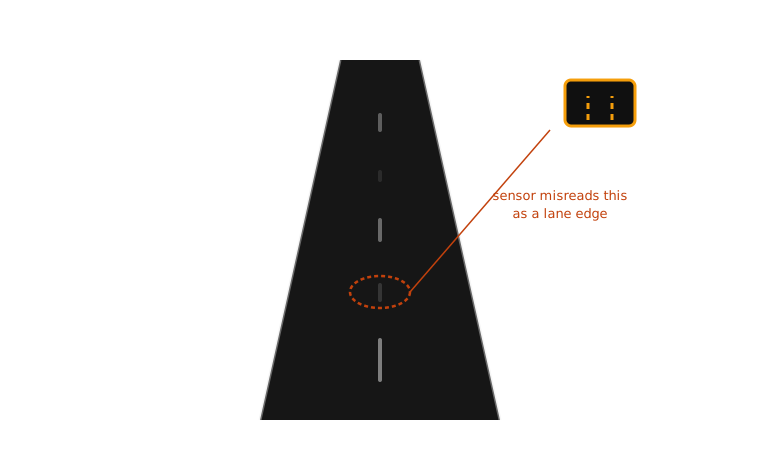
The road didn’t do anything unusual. That’s exactly why this kind of false alarm is so hard to design out.
Real example: Honda Sensing and the faded-marking problem
Honda’s Sensing suite, standard across much of its US and other-market lineups since the mid-2010s, relies on a forward camera to read lane markings for its lane-keeping assist. It is a useful example precisely because it is so widely deployed: owner forums and consumer complaint filings across those years contain a recurring, specific pattern — the system alerting or gently steering on stretches of road with worn, patched, or temporary construction-zone markings, prompting a documented subset of owners to describe turning the feature off altogether rather than tolerate the repeated correction. The complaint isn’t that the sensor malfunctions; it’s that it does exactly what it was built to do, on exactly the input that defeats it.
Real example: Tesla Autopilot and phantom braking
Tesla’s forward-collision and automatic-emergency-braking systems have drawn a specific, well-documented complaint pattern of their own: “phantom braking,” sudden hard braking triggered with no vehicle, pedestrian, or obstacle actually present, frequently reported around overpasses, shadows, or oncoming vehicles in an adjacent lane. This is a forward-collision warning’s false alarm taken to its most consequential form — a false positive that isn’t just a chime the driver can learn to discount, but an actual deceleration event other traffic has to react to. It sharpens this week’s point: a false alarm’s cost isn’t only “the driver stops trusting it” — it can be a cost paid immediately, by other road users, at the moment it fires.
Process: the alarm-fatigue feedback loop
This is not a one-way failure that happens once — it is a loop that compounds with every pass:
- System issues an alert
- Alert turns out to be a false positive (worn markings, a phantom radar return, a stopped car on an overpass)
- Driver’s trust in that specific alert type decreases slightly
- Steps 1–3 repeat, often dozens of times, across days or weeks
- Driver begins to delay their response, tune the alert out, or disable it entirely
- On the occasion the alert is correct, the driver’s response is slower than it would have been, or absent — because step 5 has already happened
- Loop back to step 1: the system keeps firing on the same schedule regardless of where the driver’s trust now sits, unless it’s been disabled — in which case the loop has ended, but so has the warning
Case study: the interface as originally designed
Lane-departure and forward-collision warnings were designed, and are mostly still built, as binary alerts: a threshold is crossed (lateral position, closing distance, time-to-collision) and the system fires at one fixed intensity, regardless of how confident the underlying sensor reading actually was. A near-certain imminent collision and a borderline, ambiguous read both produce the identical chime, tug, or flash. The design intent was reasonable and legible: keep the interface simple, keep the driver’s decision simple — alert means “look now.”
Case study: strengths, weaknesses, and consequences
The strength of a binary alert is genuine — it’s unambiguous and fast to learn, with nothing for the driver to interpret about degree. The weakness is exactly what this week has been building toward: because the alert carries no confidence information, a low-confidence false positive and a high-confidence correct warning look and feel identical to the driver, and get folded into the same running trust estimate. Every faded-marking false alarm degrades the same trust account that a genuine, high-confidence warning will later need to draw on. The consequence isn’t abstract — it shows up as documented disabling behaviour, as with Honda Sensing above, and as slower or absent response to the alert that does turn out to matter.
Case study: toward a synthesis
A binary alert isn’t the only option a confidence-scored sensor reading allows. Several current systems have started moving toward graded alerting — a soft, low-intensity cue for a borderline or low-confidence read, and the full chime-plus-intervention reserved for high-confidence cases — rather than asking one fixed-intensity alert to represent every confidence level identically. This doesn’t eliminate false alarms; sensors will always misread some inputs. What it changes is the cost of being wrong at low confidence, and it preserves more of the driver’s trust for the alerts that actually need it.
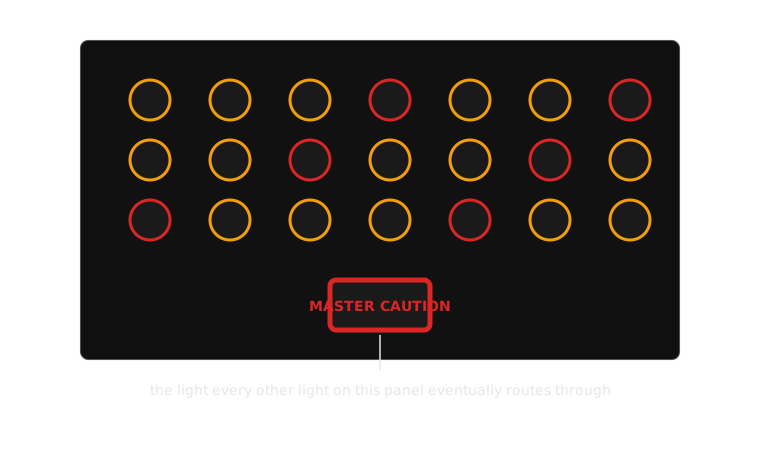
Aviation studied alarm fatigue here first — long before a lane-departure chime existed to inherit the same problem.
Comparison: tuning the same feature toward sensitivity or specificity
Take one feature — forward-collision warning — and hold the hazard fixed. The manufacturer still has to choose where on the sensitivity/specificity trade-off to sit:
| Aspect | High-sensitivity tuning | High-specificity tuning |
|---|---|---|
| False-positive rate | Higher — fires on ambiguous or borderline cases | Lower — fires mainly on clear, high-confidence cases |
| Missed-detection rate | Lower — few genuine hazards slip through | Higher — some genuine hazards fall below the firing threshold |
| Driver’s trust over time | Erodes faster, more disabling behaviour | Better preserved, but slower to react at the true edge cases |
| Failure mode when wrong | Cry-wolf effect: driver stops responding | Silent gap: system simply doesn’t warn in time |
Neither column is the safe one — each converts the same underlying uncertainty into a different kind of harm.
Classroom activity: audit a real ADAS complaint thread
Task: In pairs, find one real owner-forum thread, consumer complaint filing, or published news report describing a driver disabling or distrusting a lane-departure, forward-collision, or lane-keeping feature (Honda Sensing and Tesla Autopilot are two starting points, but any documented case counts).
Inspect: what specific road, sensor, or lighting condition triggered the false alarm being described, and how many times the driver says it happened before they disabled the feature.
Discuss:
- Does the complaint describe a sensitivity problem (too many false alarms) or a specificity problem (a missed or late detection)?
- What would a graded, confidence-scored version of this alert have done differently in the specific case described?
- Is disabling the feature entirely a reasonable response, given what this week’s mechanism predicts — or is there a narrower fix the driver didn’t have access to?

The complaint is rarely ‘it was wrong once’ — it’s almost always ‘it was wrong enough times that I stopped trusting it.’
Mini knowledge check
- Why is a false-alarm rate better described as a tuning choice than as a defect?
- Name one specific, documented automotive example from this deck of drivers habituating to or disabling an ADAS alert, and the condition that triggered it.
- Scenario: a forward-collision warning has a high positive predictive value in daytime but a much lower one at dusk, due to sensor glare. What does this week’s mechanism predict will happen to driver trust in that alert specifically at dusk, over time?
- What is the key difference between a binary alert and a graded, confidence-scored alert, and why does that difference matter for trust?
Summary
- An alert’s meaning is fixed, but a driver’s response to it is a running average of every prior time it fired — trust is a resource, not a constant
- A system’s false-alarm rate is a chosen tuning parameter (the sensitivity/specificity trade-off), not simply a bug to be removed
- Aviation identified the mechanism first: cockpit alarm research from the 1970s–80s showed trained operators reliably stop responding to alarms with low positive predictive value, regardless of training
- Documented automotive cases — Honda Sensing on faded markings, Tesla phantom braking — show the identical mechanism operating on a much shorter, more frequent exposure timeline than aviation ever had
- The feedback loop is cyclical, not one-way: it keeps compounding until the driver disables the alert, at which point it can no longer help even when it would have been right
Bridge to week 11: the same alert, a different threshold
This week treated the sensitivity/specificity threshold as a manufacturer’s design choice. It isn’t only that — it’s also a regulatory one. Euro NCAP, NHTSA and Japanese regulators each set different requirements for when a lane-departure or forward-collision system is required to warn at all, and how aggressively. The same physical car, sold in three markets, can ship with three different thresholds for “urgent enough to say something” — which means the exact cry-wolf dynamic this week described is not a fixed property of a feature, but something regulators are, in effect, choosing on the driver’s behalf, differently, depending on where the car is sold.
The tenth time it’s wrong
A warning system doesn’t lose credibility all at once. It loses it one false alarm at a time, silently, until the eleventh time — the time it’s right — arrives to find no one still listening.