Recall the end of week 10
Cross inhibition appears in brains and swarms independently. A group can hold a blind spot no member has.
The question we left open
What does all of this say about us specifically?
Where this week sits
| Now | Part | Weeks | What it does |
|---|---|---|---|
| Premise | weeks 1–2 | the constraint, and what a sense organ is for | |
| Interior models | weeks 3–7 | trace, association, map, prediction, self | |
| Control group | weeks 8–10 | other minds, as the only outside vantage | |
| → | The human case, and its limits | weeks 11–12 | the catalogue, and the blind spot |
The third part is not a tour. It is the only place a bound is visible from outside, which is what the fourth part needs.
The catalogue turns on itself
SLOP3233 · Week 11
Halvard Emms
The week the course is named after
And not the week where I list the ways you are stupid.
Three programmes
Not one
| Programme | The claim |
|---|---|
| Simon, 1955 — bounded rationality | optimising under constraint |
| Tversky & Kahneman, 1974 | systematic departures from normative models |
| Gigerenzer & Goldstein, 1996 | those departures are well matched to real environments |
The example this literature is built on
Screening, stated as probabilities
A screening test for a condition with 1% prevalence.
- if you have it, the test is positive 90% of the time
- if you do not, the test is positive 9% of the time
You test positive. What is the probability you have the condition?
Work it
P(D)      = 0.01          P(+|D)    = 0.90
P(¬D)     = 0.99          P(+|¬D)   = 0.09

P(+)      = 0.01×0.90 + 0.99×0.09
          = 0.0090 + 0.0891
          = 0.0981

P(D | +)  = 0.0090 / 0.0981
          = 0.092
About 9%, not 90%. The base rate dominates, and most people’s intuition lands an order of magnitude out.
Now the same problem in natural frequencies
Imagine 1,000 people.
10 have the condition      →  9 test positive
990 do not                 →  89 test positive  (0.09 × 990)
                              ----------------
positive tests in total    =  98
of those, actually ill     =   9

9 / 98  ≈  9%
Same arithmetic. No formula.
The moral
Performance on this task improves substantially when the identical problem is posed in frequencies rather than probabilities.
Which is Gigerenzer’s argument, in one example: the failure was partly a property of the format, not only of the reasoner. Change the representation and much of the deficit goes.
That is what “ecological rationality” means operationally, and it is why the three programmes cannot be merged.
Start with the task everyone cites
Wason’s selection task (1968). Four cards: A, K, 4, 7.
Rule: if a card has a vowel on one side, it has an even number on the other.
Which cards must you turn over?
Most people get it wrong
The logically required answer is A and 7 — the vowel, and the odd number that could falsify the rule.
Typically under 25% of participants select that pair. Most pick A and 4, which is confirmation rather than testing.
And then Cosmides changed the content
Same logical structure, different subject matter: if someone is drinking alcohol, they must be over 18. Cards showing a drink or an age.
Performance jumps dramatically, most people correctly check the beer drinker and the underage person.
Which is the whole debate in one pair of results
| Reading | What the content effect shows |
|---|---|
| Heuristics-and-biases | people fail at abstract logic and are helped by familiarity |
| Cosmides & Tooby | people were never running abstract logic — they run a cheater-detection procedure that the social version engages |
| Gigerenzer | the abstract version is an ill-posed question about an unfamiliar environment |
Cosmides, Cognition 31(3), 187–276 (1989).
Simon was never a deficiency account
Satisficing is not failing.
It is what optimisation looks like when search is expensive.
Gigerenzer’s less-is-more
The recognition heuristic sometimes outperforms more information.
Take-the-best beats regression on some real datasets.
Simplicity as accuracy. Not as compromise.
The popular version merged all three into “your brain is buggy”. None of the three authors believes that.
Simon was never a deficiency account
Bounded rationality (1955) is about optimising under constraint: computation costs, search costs, information is incomplete.
Satisficing — take the first option above a threshold — is the rational policy when search is expensive. It is not failing to optimise. It is optimising including the cost of optimising.
Which is a different claim from the next one
| Programme | Claim | Normative baseline |
|---|---|---|
| Simon, 1955 | agents optimise under constraint | constrained optimum |
| Tversky & Kahneman, 1974 | agents depart systematically from normative models | unconstrained optimum |
| Gigerenzer & Goldstein, 1996 | those departures are well matched to real environments | performance in the world |
The popular version merged all three into “your brain is buggy”. None of the three authors holds that.
The third one makes a testable prediction
Gigerenzer’s less-is-more claim: with limited data, a heuristic using one cue can outperform a model using all of them, because complex models fit noise.
So I tried to reproduce it.
And it did not reproduce
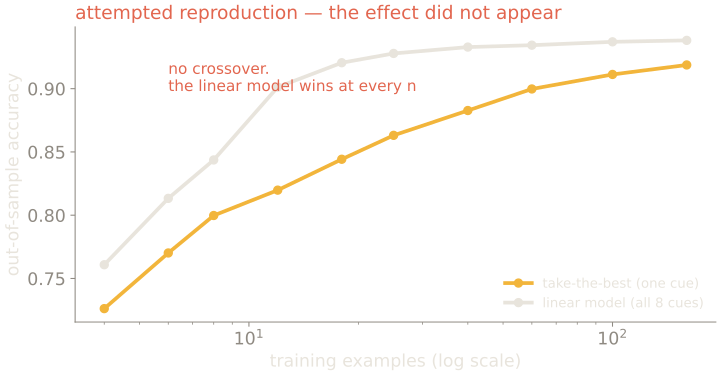
Two environment structures tried. Non-compensatory means each cue outweighs every later cue combined, which is the structure the claim is stated for.
No crossover in either.
What that licenses, and what it does not
It does not refute Gigerenzer & Goldstein. Their demonstrations used a specific real environment — German city populations — recognition rather than validity-estimated take-the-best, and cue sets with known structure. An abstract simulation is not the same test.
It does suggest the effect is more condition-dependent than its popular statement implies, since a plausible reading of the stated conditions was not sufficient to produce it.
The honest conclusion is about my simulation, not about their claim. Knowing which is the skill.
What did not hold
The record this has to be read against
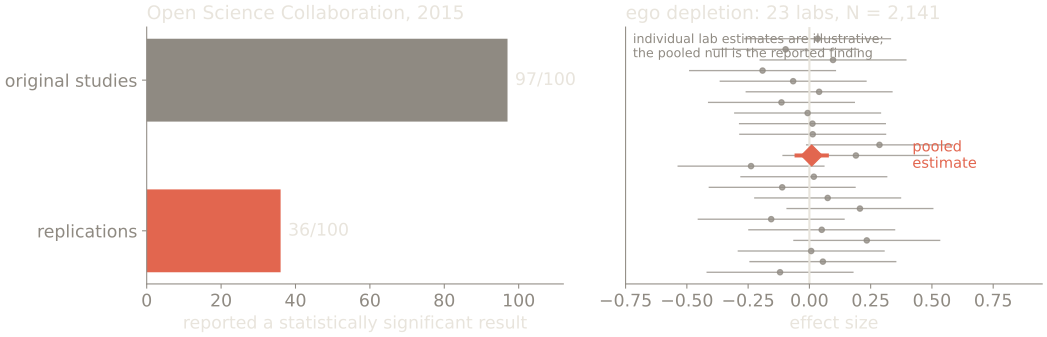
OSC, Science 349(6251), aac4716 (2015).
Ego depletion
23 laboratories. Preregistered. N = 2,141.
No effect.
Carter et al., 2015 had already challenged the resource account meta-analytically.
And it is not only psychology
- Many Labs: some classic effects replicate robustly across dozens of sites; others vanish entirely
- Camerer et al.: replications in experimental economics and social science, with success rates well below what the original literature implied
- Replication effect sizes average roughly half the originals, which matters even where statistical significance survives
The pattern is not “psychology is broken”. It is that published effect sizes are systematically inflated, for structural reasons rather than individual ones.
Why structural
Journals preferred novel positive results. Analytic flexibility was undocumented and unpoliced. Direct replications were hard to publish, so nobody was rewarded for running them.
Every incentive in that list is institutional. None requires anyone to behave dishonestly — which is the same shape as Stentor in week 3 and Clever Hans in week 4.
And more
- social priming, largely collapsed
- the dual-process framing itself — contested (Melnikoff & Bargh, The Mythical Number Two)
- Open Science Collaboration, 2015, the background rate
Kahneman, on his own book
Conceded that the priming chapter of Thinking, Fast and Slow rested on literature that did not hold.
What replaced them
The spec asks you to name three collapses and what stands in their place, so:
| Collapsed | What replaced it |
|---|---|
| Ego depletion as a limited resource | motivation and opportunity-cost accounts; attention allocation rather than fuel |
| Social priming as automatic behavioural control | much smaller, context-dependent effects; most of the striking demonstrations withdrawn |
| Two discrete systems | continuous accounts where “intuitive” and “deliberate” differ by degree, not kind |
| Bias catalogue as a list of defects | ecological rationality — performance judged against the environment rather than a norm |
Note that none of the replacements is “nothing”. The phenomena did not vanish; the explanations were too strong.
So what is this week for
A course called How and Why You’re Dumb that recited this canon would be committing the error it claims to diagnose.
The literature on human error
is subject to human error.
And there is no vantage point outside that.
Which applies to this course
Every grade on this site was assigned by someone with the same architecture weeks 3 to 7 described. The reading list was selected under the same constraints.
You have already seen one instance: I could not reproduce a claim I teach, and the only reason you know is that I said so.
So there is an obvious question
If the account is right, it applies to the account.
Next week does not escape that. It works out what follows from accepting it — which is not scepticism, and not permission to believe anything.
The move that should be standard
Adversarial collaboration. Mellers, Hertwig & Kahneman (2001) on the Linda problem: two camps who disagreed designed a study together, in advance, with agreed interpretations of each possible outcome.
Kahneman championed it. You meet it again next week, in consciousness research, at field scale.
Gigerenzer’s “bias bias”
The field systematically over-diagnoses irrationality —
by comparing behaviour against norms that do not apply.
I think he is partly right. Tell me why he isn’t.
Your revision is due this week
It should be harder to write after this seminar than before it.