Recall the end of week 9
Most of an octopus’s nervous system is not in its brain, and Nagel’s question may presuppose something false.
The question we left open
Does the unit doing the cognition have to be an individual at all?
Where this week sits
| Now | Part | Weeks | What it does |
|---|---|---|---|
| Premise | weeks 1–2 | the constraint, and what a sense organ is for | |
| Interior models | weeks 3–7 | trace, association, map, prediction, self | |
| → | Control group | weeks 8–10 | other minds, as the only outside vantage |
| The human case, and its limits | weeks 11–12 | the catalogue, and the blind spot |
The third part is not a tour. It is the only place a bound is visible from outside, which is what the fourth part needs.
Cognition outside the individual
SLOP3233 · Week 10 · Rosalind Achebe
Week 3 put a memory in a slime trail
If a capacity can live on the substrate, it can live in a group, a tool, or a notebook.
At which point where the cognition is stops having an obvious answer — and the last of the comparative weeks moves the unit of analysis.
Part 1 — the strongest evidence on this course
The problem a swarm has to solve
A colony divides. Half leaves with the old queen and clusters on a branch.
It now has days to choose a new nest cavity, from several candidates, with no individual able to inspect more than one, and a wrong answer kills the colony over winter.
How the evidence arrives
Scouts find candidate sites, return, and dance for them. Dance vigour scales with site quality.
Other scouts are recruited, visit, and dance in turn. So support accumulates in proportion to quality.
That much was known from Lindauer onward, and it looks like simple positive feedback.
But positive feedback alone deadlocks
Two good sites, each recruiting, each growing. Nothing resolves.
And a swarm that splits between two cavities dies.
So something must break ties. The question is what.
Seeley et al., 2012
Scouts produce stop signals — a brief vibrational pulse delivered to a dancing bee, which causes her to cease dancing.
And the targeting is the finding: a scout preferentially signals bees dancing for sites other than her own.
Science 335(6064), 108–111.
Which is a circuit you have already met
Say what this is and is not
It is not “a swarm is a bit like a brain”.
It is the same computational motif, mutual inhibition between evidence-accumulating populations — performing the same function, deadlock breaking, with the same signature: faster decisions when evidence is lopsided, slower and more accurate when close.
Thirteen orders of magnitude apart in substrate, with no common ancestor that had it.
Why that matters for the account
Convergent evolution of a mechanism, not a behaviour.
Which is much stronger evidence that we have been describing a class of solutions to a class of problems, rather than a set of facts about animals.
The follow-up worth knowing
Pais, Hogan, Schlegel, Franks, Leonard & Marshall (2013, PLOS ONE) showed the same cross-inhibition architecture produces value-sensitive decision making: the system commits quickly when options are good, and deliberates when they are poor.
A property nobody designed in. It falls out of the motif.
Part 2 — so where is the mind?
Clark & Chalmers, 1998
The Extended Mind, Analysis 58(1), 7–19.
Otto has Alzheimer’s and relies on a notebook. Inga has an ordinary memory. Both retrieve the museum’s address and act on it.
If the functional role is what matters, the notebook is part of Otto’s cognitive system — not an input to it.
The parity principle
If a process in the world functions as a process in the head would, and we would call the latter cognitive, then it is cognitive.
Deliberately symmetrical. The burden is on the objector to say why location should matter.
Adams & Aizawa’s objection
The coupling-constitution fallacy.
That a system is causally coupled to a resource does not make the resource part of the system. My eye is coupled to a photon; the photon is not part of my visual system.
Their charge is that the argument slides between coupling and constitution and treats the slide as an inference.
The reply, and where it stands
Clark’s response: the parity principle was never about any coupling, but about a resource that is reliably available, automatically endorsed, and easily accessible, which the photon is not and the notebook is.
Rupert presses further, arguing the resulting notion of memory is too heterogeneous to do scientific work.
[C], and you should be able to state both sides. This is one of the two weeks where philosophy is load-bearing rather than decorative.
And a real case to test it on
Hutchins, Cognition in the Wild (1995): navigating a naval vessel.
The fix is computed by a distributed system of people, charts, instruments and procedures. No individual on the bridge knows the ship’s position. The system does.
Ask whether that is a metaphor. Then ask what would settle it.
Part 3 — and groups fail in their own way
The classic result
Galton, 1907: the median guess of a crowd at a livestock fair beat the experts at estimating an ox’s weight.
Averaging cancels independent errors, so a crowd of noisy estimators can be more accurate than any of its members.
Note the word doing the work: independent.
Work out why a crowd is accurate at all
Suppose 60 people each estimate a quantity, independently, with individual standard deviation 21 and no shared bias.
The standard error of their mean is:
SE = σ / √N = 21 / √60 = 21 / 7.75 = 2.7One person is off by about 21. The average is off by about 2.7. That factor of √60 is the whole of the wisdom of crowds.
Now break the independence
Split each person’s error into a shared part and a private part:
error = shared bias + private noiseAveraging cancels the private noise. It does nothing to the shared bias, because it is the same in every estimate.
if shared bias = 6.7 : SE of mean → 6.7, not 0Which explains the finding exactly
Influence makes people’s estimates resemble each other. That converts private noise into shared content.
before influence :  spread 21.0    collective error 6.7
after  influence :  spread  1.6    collective error 6.7
The moral
Averaging is a variance trick, not a truth trick. It removes the part of the error that differs between people, and nothing else.
Confidence is read off agreement. Influence manufactures agreement without touching accuracy — so it produces a group that is more certain and no less wrong.
Lorenz et al., 2011
N = 144. Estimation tasks with real answers. Participants could see previous estimates — either the average, or the individual values.
Mild social influence was enough to change the outcome.
PNAS 108(22), 9020–9025.
What changed, and what didn’t
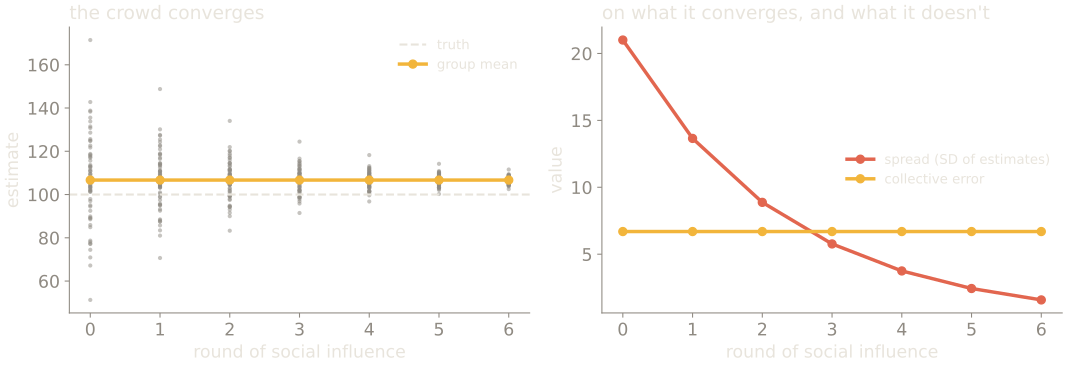
Simulation of the mechanism, not their data.
The mechanism, stated plainly
Averaging is a variance-reduction trick. It cancels independent error.
Influence removes independence. So the spread collapses, and the shared component of the error, which averaging never removed, is untouched.
Spread 21 → 1.6. Error 6.7 → 6.7.
The group became far more confident and no more accurate. Confidence is read off disagreement, and disagreement is what vanished.
And a group’s blind spot is not the sum of its members’
Each member can be individually well calibrated and the group still wrong, if the error is shared.
Which is a new failure mode. Nothing in weeks 1 to 9 has this shape.
Becker, Brackbill & Centola, 2017
The rebuttal, and it is a good one.
In decentralised networks — no one has a global view, influence is local — social influence improves group accuracy. Theory and experiment.
PNAS. So the effect depends on topology.
Which is the honest resolution
| Structure | Influence |
|---|---|
| Centralised — everyone sees the same aggregate | degrades accuracy |
| Decentralised — local, partial views | improves accuracy |
The literature does not disagree about people. It disagrees about network shape, which is a much more tractable question and a much more useful finding.
Informational cascades
Informational cascade: each person rationally weighs others’ choices above their own private information, so an early consensus propagates regardless of what anyone actually knows.
Bikhchandani, Hirshleifer & Welch (1992), Journal of Political Economy 100(5), 992–1026.
If each person rationally weighs others’ choices, early decisions can lock in a consensus that nobody’s private information supports — and each individual step is defensible.
Fashion, bank runs, citation patterns, and the reason “everybody knows” is weak evidence.
And a cascade is invisible from inside it, because every individual step was reasonable. That is the ant’s problem at group scale, and the last piece week 12 needs.
What week 10 established
Four things
- Cross inhibition appears in brains and in swarms, independently, a convergent mechanism, which is the strongest comparative evidence available.
- Whether a notebook is part of a cognitive system or coupled to one is unresolved, and the distinction is doing real work.
- Averaging only helps while errors are independent, and influence is what removes independence.
- A collective can have a blind spot no member has — the first genuinely new failure mode since week 3.
Weeks 8 to 10, in one line
Other minds are not a tour. They are the only vantage point from which a bound is visible.
You can state a bee’s limits, an octopus’s, a swarm’s.
Week 11 turns to the one you are inside.
Next week
The human case —
and the discovery that the literature about how badly you reason is itself unreliable.