Recall the end of week 8
Everything in the account runs on a million neurons. An ant stores a vector rather than a route, so it cannot audit its own error.
The question we left open
Does the account survive an animal built on a different plan entirely?
Where this week sits
| Now | Part | Weeks | What it does |
|---|---|---|---|
| Premise | weeks 1–2 | the constraint, and what a sense organ is for | |
| Interior models | weeks 3–7 | trace, association, map, prediction, self | |
| → | Control group | weeks 8–10 | other minds, as the only outside vantage |
| The human case, and its limits | weeks 11–12 | the catalogue, and the blind spot |
The third part is not a tour. It is the only place a bound is visible from outside, which is what the fourth part needs.
Another architecture entirely
SLOP3233 · Week 9
Rosalind Achebe
Part 1 — a different architecture
Not a differently-sized version
Of anything in weeks 1 to 8.
A different architecture, solving overlapping problems.
Where the neurons are
Most of an octopus’s neurons are in its arms.
Which act with substantial independence.
“What does the central controller represent?” imports a vertebrate assumption before the investigation starts.
Reading
Godfrey-Smith, Other Minds — the synthesis.
Hochner, 2012, the neurobiology.
Part 2 — where the nervous system is
Where the neurons actually are
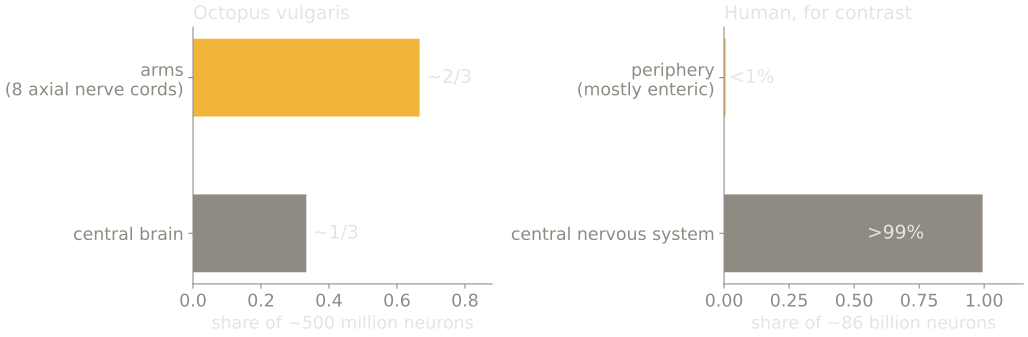
Hochner, Current Biology 22(20), R887–R892 (2012).
Work the distribution
total neurons, Octopus vulgaris   ≈  500,000,000
share in the arms                 ≈  2/3
neurons in the arms               ≈  333,000,000
arms                              =  8
                                     ---------------
per arm                           ≈   42,000,000
Sanity check against a familiar nervous system: a mouse brain holds roughly 71 million neurons in total.
Which gives the comparison worth remembering
one octopus arm   ≈  42 million neurons
one whole mouse   ≈  71 million neurons

42 / 71  ≈  0.6
A single arm carries around 60% of a mouse brain, and it will complete a reaching-and-grasping programme after being severed from the animal.
The moral
“Distributed nervous system” is a phrase. Eight semi-autonomous units of forty million neurons each is a claim about what kind of control problem the animal is solving.
And it is not the vertebrate one, which is why the vertebrate question fails here rather than merely fitting badly.
And the arms act on it
A severed octopus arm will still complete motor programmes — reaching, grasping, passing an object along itself.
The axial nerve cord generates and terminates the behaviour locally. Central command is not issuing the movement; at most it is requesting one.
Which makes the vertebrate question malformed, not merely inapplicable
“What does the central controller represent?” presupposes a central controller doing the representing.
In an animal where most of the nervous system is distributed and locally autonomous, that question imports its answer before the investigation starts.
A forward link worth making
An octopus is not a colony. But the control problem it solves, coordinating semi-autonomous units holding local information — is closer to a swarm’s than to ours.
Same problem, different substrate. Next week, in bees.
Nagel, 1974
What is it like to be a bat?
Four words that have done more work in philosophy of mind than almost any others.
The claim: there is something it is like, and we have no access to it.
Akins’ objection
The question may presuppose something false —
that bat sensory systems are representational in the way the question requires.
Why that matters enormously
| If | Then our failure to answer |
|---|---|
| The question is well-formed | tells us about the limits of imagination |
| The question is malformed | tells us about the question |
I have no settled view
The seminar is genuinely open.
This is one of two weeks where I argue against my own lecture.
The disjunction under the question

Why the disjunction matters more than either branch
In both cases we cannot answer.
On the first branch that is a fact about us, the limits of what can be imagined from inside one sensory life.
On the second it is a fact about the question, which was built on a premise about bats that may be false.
Same inability. Opposite conclusions. And introspection cannot tell you which.
Akins’ argument, stated rather than gestured at
Bat sensory systems may be better described as organised around action — tracking what matters for the next wingbeat — than as building a representation of how the world is.
If there is no world-model of the relevant kind in there, there may be no “what it is like” of the relevant kind to fail to imagine.
Grade [C]. This is genuinely open and I do not have a settled view.
A test of the account
Cuttlefish and delayed gratification
Schnell et al. (2021, Proc. R. Soc. B): cuttlefish forgo an immediately available but less-preferred prey item to wait for a preferred one.
Waiting up to roughly 130 seconds, and individual performance correlated with learning performance in a separate reversal-learning task.
Why that result belongs in weeks 8–10
Delayed gratification is usually framed as requiring future-oriented control, and discussed almost entirely in primates and corvids.
A cephalopod arriving at it independently is exactly the convergence evidence these three weeks exist to collect.
[C] — one paradigm, modest samples, and the inference from waiting to self-control is the contestable step.
And a question with legal consequences
Birch and colleagues’ 2021 review for the UK government assessed evidence for sentience across invertebrate groups.
Cephalopods and decapods were judged to have strong enough evidence, and both were subsequently brought into UK animal welfare legislation.
Note what happened there
A question this course treats as unresolved was operationalised into law, because a decision had to be made either way.
Suspending judgement is a luxury of the seminar room. Regulators do not have it, and they made the call on the evidence available.
An unsolved problem
Cephalopods are colourblind
One photoreceptor type. As far as we can tell.
And they produce colour-matched camouflage
Precisely. Against backgrounds they apparently cannot see the colour of.
Stubbs & Stubbs, 2016
Chromatic aberration plus an unusual pupil shape could recover spectral information from a single channel.
Ingenious. Not established.
[S] leaning [C]
What an open problem looks like from outside
We can draw the shape of what we do not know about an octopus: one photoreceptor, precise colour matching, no accepted mechanism.
The equivalent gap in our own case has no outline. That difference is the whole reason these three weeks exist.