Recall the end of week 6
Perception is largely generated and checked against input. Nothing tags which parts were sensed and which were constructed.
The question we left open
What happens when the model the system builds includes the modeller?
Where this week sits
| Now | Part | Weeks | What it does |
|---|---|---|---|
| Premise | weeks 1–2 | the constraint, and what a sense organ is for | |
| → | Interior models | weeks 3–7 | trace, association, map, prediction, self |
| Control group | weeks 8–10 | other minds, as the only outside vantage | |
| The human case, and its limits | weeks 11–12 | the catalogue, and the blind spot |
The third part is not a tour. It is the only place a bound is visible from outside, which is what the fourth part needs.
Modelling the modeller
SLOP3233 · Week 7 · Tuyet Nabarro
Where week 6 left you
Perception is largely generated, and nothing tags which parts.
Today the model turns on the thing doing the modelling — and the same problem appears, one level up.
Part 1 — a constraint before any evidence
The compression is not optional

Why it has to be lossy
A complete model of a process cannot run inside that process at full resolution. The model would need at least as much capacity as the thing modelled, and it is a part of it.
So the self-model is a summary. That much is structural, and follows from week 1’s constraint rather than from any experiment.
Put a number on the compression
A conservative accounting of what a self-model would have to cover:
cortical neurons                    ≈  1.6 × 10^10
synapses                            ≈  1.0 × 10^14
And what a report can carry:
speech, sustained                   ≈  40 bits/second
a 2-minute answer                   ≈  4,800 bits
The ratio is the point
10^14 synaptic states → ~5 × 10^3 bits of reportThe compression is not lossy at the margins. It discards essentially everything, and what survives was selected by something you also cannot inspect.
Sanity check: the exact numbers do not matter. Change them by four orders of magnitude in either direction and the conclusion is unchanged.
The moral
“Introspection is a summary” sounds like a caution about accuracy.
Put the ratio in and it is stronger than that: the report and the process are not the same kind of object, and no amount of care in reporting closes a gap of ten orders of magnitude.
And a summary does not carry a note saying what it left out.
What that predicts
If introspection reads a summary, then introspective reports should be:
- fluent, the summary is compact and easy to read
- confident — nothing in it flags its own incompleteness
- wrong in specific ways, wherever the dropped detail mattered
- not correctable by effort — you cannot introspect harder onto missing data
All four are testable. The last three have been tested.
Metzinger’s version
Being No One (2003): the self is a phenomenal self-model, a representation the system builds and then fails to recognise as a representation.
The philosophical claim is strong and contested. The empirical work below is more unsettling than the philosophy, which is unusual.
Part 2 — Nisbett & Wilson, 1977
Telling more than we can know
A review, not an experiment, and still one of the most cited papers in the field. Psychological Review 84(3), 231–259.
Their survey: across many studies, people asked why they behaved as they did produced confident accounts that did not match the manipulations actually driving the behaviour.
Their explanation
Reports are not read off the process.
They are generated from plausible theories about what would cause such behaviour — the same theories an observer would use.
Which predicts something specific: an observer with the same background knowledge should be about as accurate as the actor. Often they are.
Part 3 — the experiment that makes it vivid
The design

Johansson, Hall, Sikström & Olsson, Science 310(5745), 116–119 (2005).
The numbers
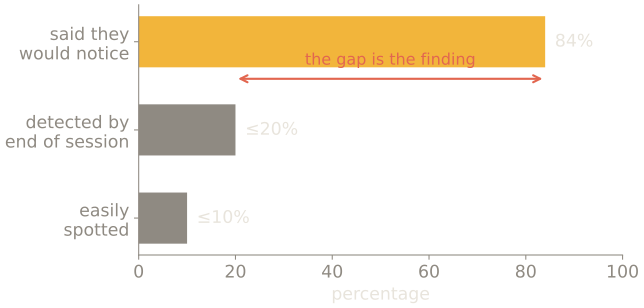
And then they explained it
Not “I don’t know”. Not hesitation.
Participants gave reasons — citing features unique to the face they had actually turned down. The blonde hair they had rejected became the reason they chose her.
Why this is worse than an error
An error is a wrong output.
This is a confabulation: the reporting system did its job, produced fluent content, and the content was manufactured. There was no felt difference between that and a true report.
Which is exactly what a summary-reader with no completeness flag should do.
Part 4 — the objection
Petitmengin et al., 2013
You are required to know this, and most summaries of choice blindness omit it.
When participants are given space to examine their experience, an interview technique that asks them to attend to what actually happened, rather than pressure to produce an explanation —
the effect largely dissolves. Recognition of the swap, sometimes up to 45 minutes later.
So grade it properly
| Claim | Grade |
|---|---|
| Introspection is simply unreliable | [C] — does not survive Petitmengin |
| Introspection is unreliable under demand to explain | much better supported |
The weaker claim is the more interesting one
Because the conditions under which we normally deploy introspection are precisely the conditions where it fails: being asked to account for ourselves, quickly, to someone who expects an answer.
Interviews. Exams. Arguments. Therapy. Seminars.
Part 5 — an assay under too much load
The mark test
Gallup, 1970: anaesthetise a chimpanzee, apply a dye mark where it cannot be seen without a mirror, and see whether the animal inspects the mark on itself.
Science 167(3914), 86–87. For fifty years, the standard operationalisation of self-recognition.
Kohda et al., 2019
Cleaner wrasse pass it. Labroides dimidiatus — a fish — showed throat scraping against surfaces after a brown mark was applied to its throat, visible only in the mirror.
PLOS Biology 17(2), e3000021.
De Waal’s commentary, same issue
Three objections, and they are methodological rather than dismissive:
- MSR requires that social responses to the mirror have been replaced by self-directed behaviour first
- The mark should be purely visual — the brown throat mark may have been physically irritating
- No prior training
His verdict: an intermediate level of mirror understanding, closer to monkeys than hominids. PLOS Biology 17(2), e3000112.
And Gallup objected too
The inventor of the test argued against the interpretation. Sample size was four fish. The scraping could reflect an attempt to remove an irritant rather than self-inspection.
Kohda et al., 2022
They returned with more.
17 of 18 cleaner fish — 94% — showed the same behaviour. The largest sample tested for MSR in any non-human species outside chimpanzees, with the highest pass rate at that sample size.
PLOS Biology 20(2), e3001529.
We are not going to settle it
And the reason it is on the course is not the fish.
The argument is about what the test was ever a test of.
Unpack that
The mark test measures: does the animal use mirror-reflected information to direct behaviour at its own body?
The inference runs from that to self-awareness, which is a much larger claim, and the inference was never licensed by the assay.
A behavioural test carrying a philosophical conclusion is the structure to notice here, you will meet it again in week 12 with integrated information theory.
A useful counter-critique
A commentary in Learning & Behavior argued the reaction to Kohda’s result revealed more about scientists’ priors about phylogeny than about self-awareness.
Conclusions about a species should rest on the whole corpus rather than one test and an expectation about where in the tree the animal sits.
Which is a Clever Hans point about the experimenters, from week 4.
What week 7 established
Four things
- The self-model is necessarily a summary — that is structural, not empirical.
- Reports are generated, not read off, and the generator is fluent.
- The unreliability is situational, and the situation is the ordinary one.
- An assay can be asked to carry a conclusion it never licensed.
And the pattern, for the fourth week running
| Week | System | Cannot detect |
|---|---|---|
| 3 | slime trail | own trail versus stale |
| 4 | association | cause versus coincidence |
| 5 | the map | its own distortion |
| 7 | the self-model | what the summary dropped |
Week 12 asks what follows when the system in the last row is the one reading this table.
Next week
Everything so far, running on a million neurons.
And an ant that counts its own strides.