Recall the end of week 5
A map lets you act on what you are not touching. It distorts in predictable directions, and reports nothing about its own deformation.
The question we left open
Where does the content of a representation actually come from?
Where this week sits
| Now | Part | Weeks | What it does |
|---|---|---|---|
| Premise | weeks 1–2 | the constraint, and what a sense organ is for | |
| → | Interior models | weeks 3–7 | trace, association, map, prediction, self |
| Control group | weeks 8–10 | other minds, as the only outside vantage | |
| The human case, and its limits | weeks 11–12 | the catalogue, and the blind spot |
The third part is not a tour. It is the only place a bound is visible from outside, which is what the fourth part needs.
Perception as construction
SLOP3233 · Week 6 · Tuyet Nabarro
Five weeks pointed one way
world → sense organ → representation
Measurement, then valuation, then a trace, then association, then a map.
Each week added something that made the inward journey richer.
Today it reverses
The claim
The system generates what it expects.
Only the mismatch travels up.
What you experience is mostly manufactured internally and checked against input, rather than delivered by it.
Three things that get conflated
| Term | What it is | Scope |
|---|---|---|
| Predictive coding | a specific proposal about neural implementation | narrow, testable |
| Predictive processing | a framework for perception and action | broad |
| The free energy principle | a mathematical claim about self-organising systems | very wide |
Published work runs these together constantly. Keeping them apart is most of what it takes to read this literature carefully.
Who to attribute what to
Rao & Ballard, 1999 — predictive coding in visual cortex. The implementation-level proposal.
Clark, 2013 — “Whatever next?”, Behavioral and Brain Sciences 36(3), 181–204. The framework, stated for a general audience. Your reading.
Friston, 2010, the free energy principle, Nature Reviews Neuroscience 11(2), 127–138. The ambitious unification.
Part 1 — why a system would do this
Because the channel is narrow
The optic nerve is a bottleneck, not a cable.
Roughly 10⁸ photoreceptors feed roughly 10⁶ ganglion cell axons. Two orders of magnitude of compression before the signal has left the eye.
Whatever leaves has already been thrown away. The question is only what principle governed the throwing.
Barlow’s answer, 1961
Efficient coding. A sensory system should recode its input to remove redundancy, because redundancy is capacity spent on what the receiver could have worked out.
Natural scenes are enormously redundant: neighbouring points are correlated, so most of each sample is predictable from its neighbours.
So measure the saving
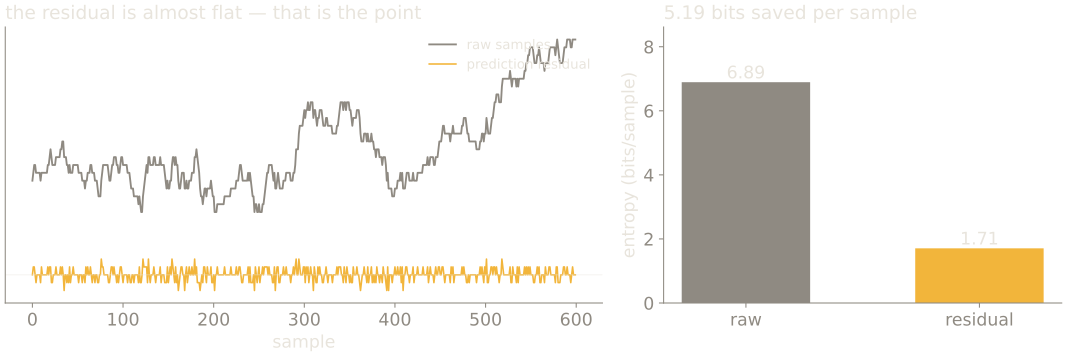
Simulated signal with the 1/f² power spectrum measured in natural scenes (Field 1987; Ruderman & Bialek 1994), quantised to 256 levels.
The number
6.89 bits per sample raw. 1.71 bits as residuals.
A 75% saving, from a predictor of almost no sophistication — it simply assumes the next sample resembles the last.
That is the efficiency argument, computed rather than asserted.
And the architecture that follows
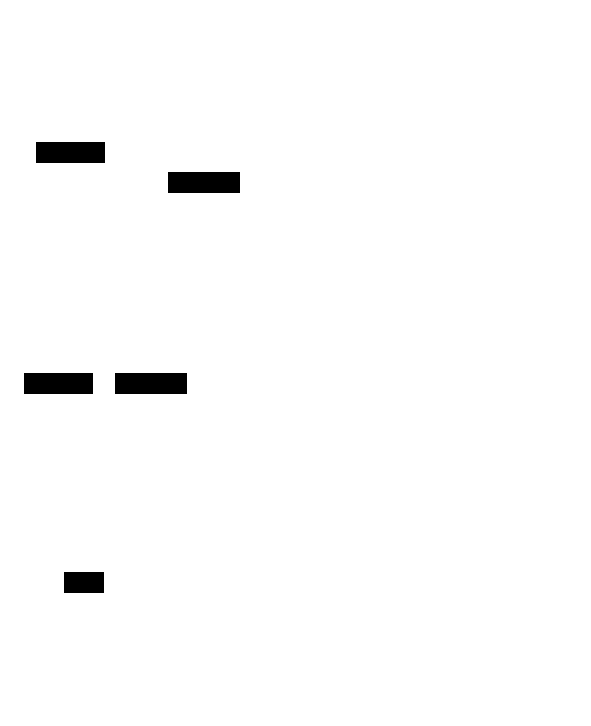
The asymmetry is the claim. A level that predicts its input perfectly is silent.
Part 2 — what it explains
Illusions stop being a list
On a passive view, an illusion is a malfunction, a place where the machinery breaks.
On this view an illusion is the machinery working, on input engineered to make a normally-good inference come out wrong.
That reclassification is the framework’s strongest asset.
Constructed, not reproduced
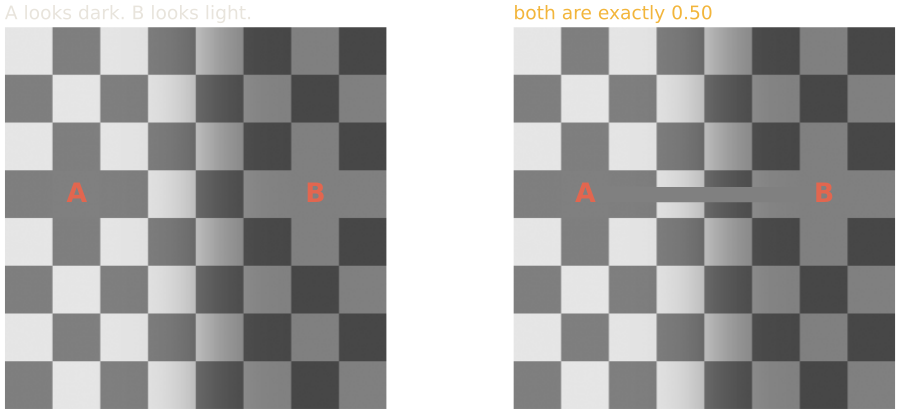
Independent implementation of Adelson’s checker-shadow effect — our pixel values, not his figure.
The values are exact, not approximate
rendered luminance = reflectance × illumination

  dark check, full light :  0.50 × 1.0000  = 0.5000
  light check, in shadow :  0.90 × 0.5556  = 0.5000
A = 0.5000. B = 0.5000. The script asserts it rather than claiming it.
And knowing does not help
You have now seen the proof. Look at the left panel again.
The inference runs below the level at which knowing operates, so propositional knowledge has no purchase on it.
Evidence of the same shape
- Binocular rivalry, conflicting input to each eye produces alternation, not a blend. The system commits to a hypothesis, then switches.
- Bistable figures — Necker cube, Rubin vase. One stimulus, two stable interpretations, no intermediate.
- The hollow mask — a concave face is seen as convex, because faces are convex and the prior is overwhelming.
- Change blindness, large changes across a disruption go unnoticed (Rensink, O’Regan & Clark, 1997).
- Inattentional blindness — Simons & Chabris’s gorilla, 1999.
What unifies that list
In every case the system’s prior wins over the input.
And in every case the observer has no sense of a contest having taken place. The output arrives as perception, not as a conclusion.
Part 3 — the extensions
Attention as precision
Precision, in this literature, is the inverse variance assigned to a prediction error: how much weight a given mismatch is allowed to carry.
Attention, on this account, isn’t a spotlight that brightens a region.
It’s the weighting applied to prediction error — how much a given mismatch is allowed to revise the model.
Which makes attention a parameter of inference rather than a separate faculty.
Work a precision-weighted update
A prediction and an observation disagree. The posterior is the precision-weighted average, where precision π is inverse variance:
prior:        μ_p = 10.0,  σ_p = 1.0   →  π_p = 1/1.0² = 1.00
observation:  μ_o = 16.0,  σ_o = 2.0   →  π_o = 1/2.0² = 0.25

posterior μ = (10.0×1.00 + 16.0×0.25) / (1.00 + 0.25)
            = (10.00 + 4.00) / 1.25
            = 11.2
The observation was 6 units away and moved the estimate by 1.2.
Now make the senses trustworthy
Same disagreement, but σ_o = 0.5 instead of 2.0, so π_o = 4.00:
posterior μ = (10.0×1.00 + 16.0×4.00) / (1.00 + 4.00)
            = (10.00 + 64.00) / 5.00
            = 14.8
Identical prediction error. Identical observation. The estimate moves 4.8 instead of 1.2, because the precision changed.
The moral
Precision is not a detail of the machinery. It is the only parameter that decides whether your model updates on the world or overrules it.
Which is why the same framework predicts both attention — deliberately raising the precision of one channel — and hallucination, where a prior’s precision is high enough that input cannot correct it.
Interoception, and emotion as inference
Seth’s extension: the same machinery applied inward.
Predictions about the state of the body, errors from the viscera, and emotion as the inferred cause of an interoceptive pattern.
Being You (2021) is the accessible statement. Grade the strong version [C], it is a research programme, not a settled result.
Hallucination as precision failure
If perception is inference under precision weighting, then perception can fail in a specific way: priors weighted too strongly relative to input.
That gives a principled account of why hallucination is perceptual rather than cognitive, and why it is not corrigible by argument.
Plausible, generative, and not established. [C]
Part 4 — now the objections
You are required to arrive with one
A framework that accommodates every result is in an awkward position, not a strong one.
This section is not balance for its own sake. It’s the part of the week you will be assessed on.
The dark room problem
If a system acts to minimise prediction error —
why not find a featureless dark room, stop moving, and predict perfectly forever?
The standard reply, and why it is contested
The reply invokes expected free energy: agents minimise error anticipated over future policies, which makes novelty-seeking and exploration fall out of the same principle.
Sun & Firestone press on whether that reply is doing real work, or whether the free parameters are absorbing the counterexample after the fact.
Litwin & Miłkowski: unification by fiat
The sharper methodological charge.
The framework’s apparent unifying power may come from redescribing phenomena in its own vocabulary rather than explaining them — in which case the unification is verbal, and the arrested development is the symptom.
Colombo & Wright: is it testable?
If every result is accommodated, what observation would count against it?
Ask that about the free energy principle specifically. Then ask it about predictive coding, where the answer is much better — Rao & Ballard’s proposal makes concrete claims about cortical microcircuitry that can fail.
Which is why the three-way distinction mattered
| Level of claim | Falsifiable? |
|---|---|
| Predictive coding | yes — specific circuit-level predictions |
| Predictive processing | partly — depends on the formulation |
| Free energy principle | disputed |
Grading the whole bundle at once is the mistake. Grade the levels separately.
Part 5 — what this does to the course
The consequence nobody likes
Nothing tags which parts of your experience were sensed and which were generated.
There is no marker, no felt difference, no route to the distinction from the inside.
You do not perceive the world. You perceive your best current hypothesis about it, corrected occasionally.
Two weeks ago, in an ant
The path integrator had no independent reference against which to check its own output.
This week, the same structure, in you, the system generating the hypothesis is the system evaluating it.
Week 12 is where that stops being a curiosity.
Where we go next
If perception is a model, and the model includes the body —
it can include the modeller.
That is week 7, and it is where introspection stops being a reliable instrument.
For the seminar
Bring one objection to the free energy principle,
and one observation that would move it.