Recall the end of week 4
Association tracks unexplained variance, not co-occurrence. It still cannot separate a cause from a reliable coincidence.
The question we left open
What does it buy a system to represent structure it is not currently sensing?
Where this week sits
| Now | Part | Weeks | What it does |
|---|---|---|---|
| Premise | weeks 1–2 | the constraint, and what a sense organ is for | |
| → | Interior models | weeks 3–7 | trace, association, map, prediction, self |
| Control group | weeks 8–10 | other minds, as the only outside vantage | |
| The human case, and its limits | weeks 11–12 | the catalogue, and the blind spot |
The third part is not a tour. It is the only place a bound is visible from outside, which is what the fourth part needs.
The map, and what it was really for
SLOP3233 · Week 5 · Tuyet Nabarro
What association could not do
Week 4 gave the system co-occurrence. That is enough to learn.
It is not enough to act on a part of the world you are not currently touching.
For that you need something held that is not being sensed.
Part 1 — Tolman’s heresy
The orthodoxy he was arguing with
By the 1940s the dominant account of maze learning was a chain of stimulus–response associations: at this junction, turn left; at that smell, go forward.
Learning was strengthening links. Nothing needed representing.
Latent learning breaks it
Rats allowed to wander a maze with no reward at all later learn the rewarded route faster than naive rats.
On an S–R account there was nothing to strengthen. No reward, no reinforcement, no learning.
Something was acquired anyway.
Place learning against response learning
Train a rat to food that is always in the same place, from varying start points. It succeeds.
An S–R chain cannot transfer across start points, because the required response differs from each one.
Shortcuts
Block the trained route and open a set of novel radial arms.
Rats select the arm pointing at the goal location, a route they have never run and never been rewarded for.
Tolman, 1948: something map-like, not a chain of associations.
Psychological Review 55(4), 189–208.
Part 2 — twenty-three years later, the cells
O’Keefe & Dostrovsky, 1971
Recording in rat hippocampus, they find units that fire when the animal is in a particular place in the environment — and not otherwise.
Not a response. Not a stimulus. A location.
Brain Research 34(1), 171–175.
What place cells are not
- Not tied to a sensory cue, the field persists in darkness
- Not tied to a movement — it fires regardless of heading, in an open arena
- Not a single map, the population remaps across environments
O’Keefe & Nadel’s The Hippocampus as a Cognitive Map (1978) is the synthesis.
The rest of the toolkit
| Cell type | Codes |
|---|---|
| Place cells | where you are |
| Grid cells | a periodic metric over the whole surface |
| Head-direction cells | which way you face |
| Boundary vector cells | distance and bearing to walls |
| Speed cells | how fast you are going |
Enough, in principle, to do dead reckoning — which is what week 8’s ant does with vastly less.
Hafting et al., 2005
Entorhinal cells whose firing fields tile the environment in a regular triangular lattice.
Not one place. A periodic metric.
Nobel Prize 2014 — O’Keefe, and May-Britt and Edvard Moser.
Why hexagonal?
Because interference forces it
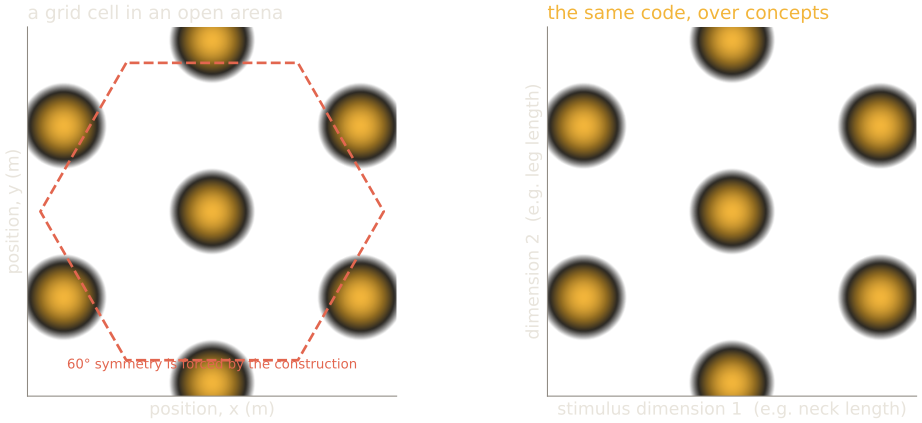
The construction
field(x, y) = Σ cos(kᵢ · x) for three wave vectors 60° apartThreshold it, and a triangular lattice is the only thing that can come out.
So 60° symmetry is not an observation about rodents. It is what summing three plane waves at 60° does, anywhere, in any medium.
Which gives the fMRI work its handle
You cannot resolve single grid cells in a human scanner.
But a population using a hexagonally symmetric code produces a six-fold periodic signal as a function of movement direction, and that you can measure.
Part 3 — the reframe
Constantinescu, O’Reilly & Behrens, 2016
Participants learn a space of morphing bird silhouettes: two continuous dimensions, neck length and leg length.
No arena. No movement. No space.
They then “navigate” it — imagining transitions from one bird to another.
The signal turns up anyway
Hexagonally symmetric, as a function of direction through the conceptual space.
In entorhinal cortex and ventromedial prefrontal cortex.
Stable across sessions acquired a week apart.
Science 352(6292), 1464–1468.
If one mechanism organises relational structure generally, space is just the instance we could see.
Why we found it in space first
Not because space is special to the brain.
Because space is observable to the experimenter, you can put an animal in a box and watch where it goes. You cannot watch it move through a space of bird shapes.
The apparatus selected the domain, and we mistook that for the subject.
The model that unifies them
Whittington et al., the Tolman–Eichenbaum Machine, Cell (2020).
One architecture in which spatial and relational memory are the same computation, with place-like and grid-like codes emerging from the demand to generalise structure across environments.
Named, deliberately, for the two people the field spent fifty years reconciling.
What this does to the course
This week stops being a step toward cognition.
It becomes closer to the substrate the later weeks run on — if concepts are navigated with the machinery of place, then the self-model of week 7, the system’s compressed representation of itself, and week 11’s categories inherit its properties.
Including its failure modes.
The honest caveat
Whether the six-fold fMRI signal really reflects grid cells, or some other periodically-tuned population, is not settled.
The inference runs: grid cells are hexagonal → this signal is hexagonal → therefore grid cells. Which is an inference to the best available explanation, not a measurement.
Grade [C], and note that the 2016 result has replicated in other conceptual domains, which strengthens it without closing it.
Part 4 — and it lies
A map buys you reach
Act on what you are not sensing. Plan a route you have not walked. Take a shortcut.
Every one of those is unavailable to the system in week 4.
What it costs
The map can be wrong in ways the map cannot represent.
Spatial memory is not a scale model with noise. It is systematically distorted, in directions you can predict.
Distortions that are reliably reproducible
- Route-based inflation, distance judged longer when the path between two points has more turns or intersections, even at equal metric distance
- Boundary effects — two points judged further apart when a boundary lies between them
- Hierarchical error, city A judged east of city B because their regions stand in that relation, when the cities do not
- Asymmetry — the distance from a landmark to an ordinary place is judged differently from the reverse
Work a distortion
Two pairs of locations, identical straight-line distance of 400 m:
pair A:  one straight street, no intersections
pair B:  four turns, six intersections, crosses a main road
Typical finding in the route-inflation literature: judged distance rises with the number of intervening turns and nodes, even when metric distance is held constant. Estimates for pair B commonly run 20–40% higher.
400 m → judged ~480–560 mAnd the shape of the error is the tell
It is not noise. Noise would scatter both pairs equally around 400.
The error is directional and predictable from the structure of the route, which means the representation is not a scale model with error added — it is a differently-shaped thing that answers metric questions by proxy.
The moral
A system can be reliably, quantifiably wrong and give no indication of it.
Ask a person for a distance and you get a number with no error bar attached, because the representation that produced it does not carry one.
That is the same failure as the ant’s odometer in week 8, three weeks early and in your own head.
The part that matters
None of those distortions is available to the person making the judgement.
There is no felt uncertainty attached to the wrong answer. The map reports a number, and reports nothing about its own deformation.
Which is the pattern, for the third time
| Week | System | What it cannot detect |
|---|---|---|
| 3 | slime trail | whether the trail is its own or stale |
| 4 | association | cause against coincidence |
| 5 | the map | its own distortion |
Three mechanisms, three blind spots, and no internal signal in any of them.
One comparative note before we leave
Menzel et al. (2005) displaced honeybees to unfamiliar release sites and tracked them by harmonic radar.
They flew novel direct routes to the hive, behaviour that map-like memory explains and vector memory alone does not. PNAS 102(8), 3040–3045.
A million neurons, doing something Tolman’s rats were doubted for.
Next week
The direction of flow reverses,
and most of what you take to be sensing turns out to be generated.