Morphology
Week 3. Composite bodies, and whether the parts form a grammar.
A composite body is assembled from a small closed set of parts.
The parts, and not the whole, are what a taxonomy can count.
The ordinary composite
有獸焉,其狀如馬而白首,其文如虎而赤尾,其音如謠,其名曰鹿蜀,佩之宜子孫。
There is a beast there, shaped like a horse with a white head, marked like a
tiger, with a red tail, and its cry is like singing. It is called 鹿蜀
(lùshǔ). Wear it and your descendants will prosper.
南山經 (Nánshānjīng, the Southern Mountains),
first section, at 杻陽之山
鹿蜀 (lùshǔ): a horse, a tiger’s markings, a red tail. Two animals and a colour.
A second ordinary case
其中多玄龜,其狀如龜而鳥首虺尾,其名曰旋龜,其音如判木,佩之不聾,可以為底。
In it there are many 玄龜, shaped like a turtle but with a bird’s head and a
viper’s tail. They are called 旋龜 (xuánguī), and their sound is like wood
splitting. Wear one and you will not go deaf.
Southern Mountains, first section, at
杻陽之山
旋龟 (xuánguī): a turtle, a bird’s head, a viper’s tail. Three animals, named as three.
Why those are easy
Both halves are animals a reader already classifies. The composite borrows their diagnoses and adds nothing.
A taxonomy can file it without deciding anything new.
This week’s four
帝江 (dìjiāng), 陆吾 (lùwú), 天吴 (tiānwú), 开明兽 (kāimíngshòu).
Two from the Western Mountains, two from beyond the 山經 (Shānjīng, the Mountains chapters). None resolves to a single animal. One resolves to no animal at all.
Count the parts
| Specimen | body | head | face | foot / claw | wing | tail | back |
|---|---|---|---|---|---|---|---|
| 帝江 | sack | — | none | six | four | — | — |
| 陆吾 | tiger | — | human | claws | — | nine | — |
| 天吴 | tiger | eight | human | eight | — | eight, ten | blue-yellow |
| 开明兽 | tiger | nine | human | — | — | — | — |
An em dash means the record does not say. 帝江’s face is the record saying there is none.
The set is small
Body, head, face, claw, foot, wing, tail, back.
Eight part-words, and colour, which is not a part but attaches to one. The four records use nothing outside that list. The vocabulary is closed before the counting starts.
有神焉,其狀如黃囊,赤如丹火,六足四翼,渾敦無面目,是識歌舞,實為帝江也。
There is a god there, shaped like a yellow sack, red as cinnabar fire, with
six feet and four wings, a shapeless blur with no face. It knows song and
dance. This is 帝江.
西山經 (Xīshānjīng, the Western Mountains),
third section, at 天山
Somebody drew it
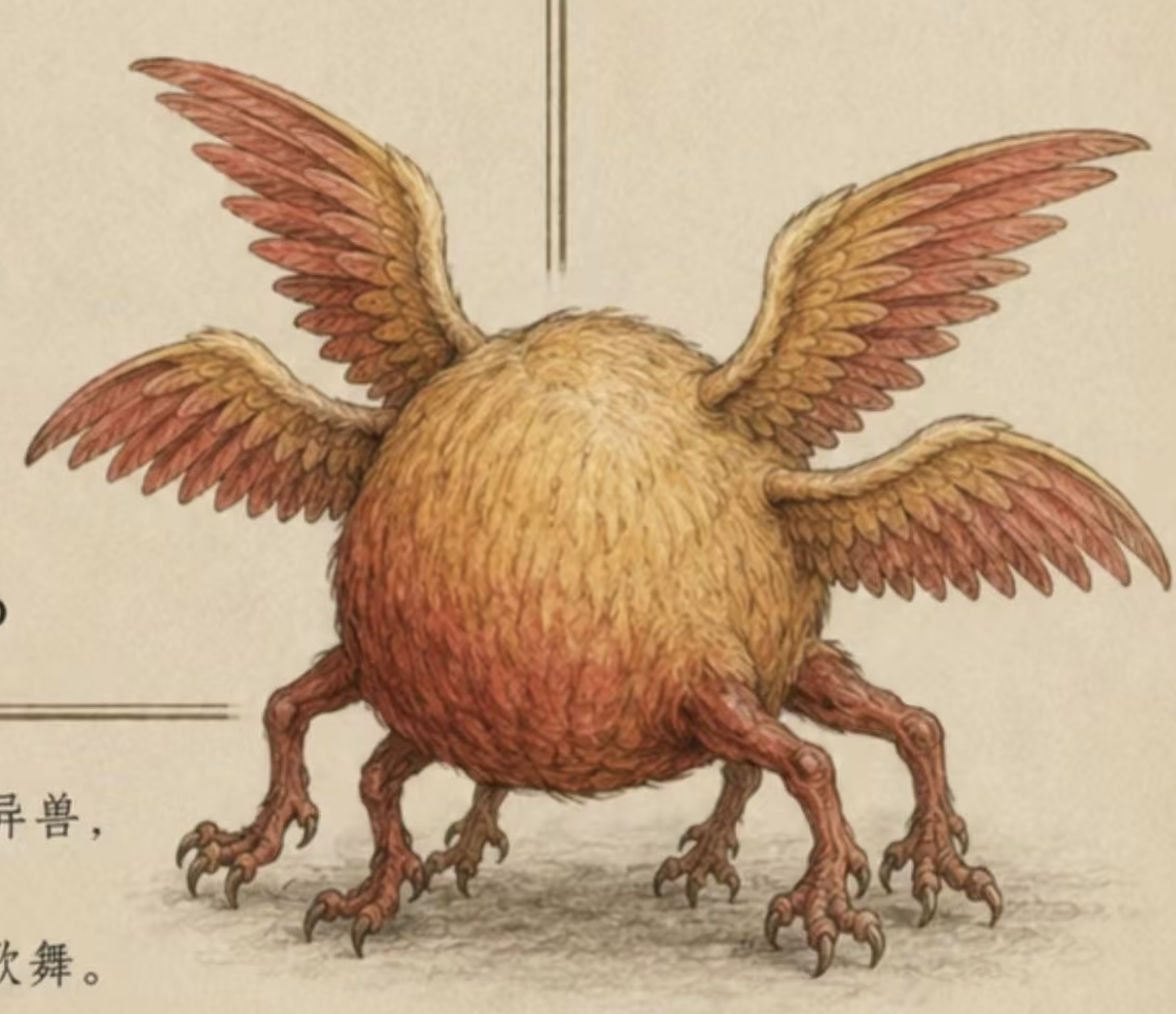
A modern reconstruction, not the record. The line gives six feet, four wings, a sack and no face. The plumage, the colour, the stance and the ground are the illustrator’s.
No animal in it
帝江 is compared to a sack. Not a horse, not a tiger, not a bird.
其狀如 names an object, and the parts stay countable: 六足四翼, six feet and four wings.
It still dances
是識歌舞 — it knows song and dance.
A body with no face and no animal in it is still described, still filed, still 神 (shén, god). Recognition is not doing the work. Counting is.
Same mountain, same parts
神陸吾司之。其神狀虎身而九尾,人面而虎爪;是神也,司天之九部及帝之囿時。
A tiger’s body, nine tails, a human face, a tiger’s claws — and it
administers the nine regions of heaven.
Western Mountains, third section, at Kūnlún開明獸身大類虎而九首,皆人面,東嚮立昆侖上。
Largely a tiger’s body, nine heads, every one human-faced, standing facing
east on top of Kūnlún.
海內西經 (Within the Seas, West)
The difference is the office
The nine moves from the tails to the heads, and the rest holds.
陆吾 is 神 and 司天之九部, administrator of the nine regions of heaven. 开明兽 carries 獸 (shòu, beast) in its own name. Anatomy does not separate them. The job does.
天吴 disagrees with itself
Two records, one name. 八足八尾, eight feet and eight tails, in 海外東經 (Beyond the Seas, East); 虎身十尾, a tiger’s body and ten tails, in 大荒東經 (the Great Wilds, East).
Only 八首人面, eight heads with human faces, survives both.
The whole is not stable enough to name.
The parts are. Count those.
Next week
Geography and habitat. Two of this week’s four sit on a route you can walk and two do not, and next week asks one habitat column to hold both.